


What you’ll achieve: By the end of this hands-on guide you will be able to choose, size, inspect, assemble, and organize a closet armoire as a freestanding furniture solution for bedrooms, hallways, and living areas. Plan on 2–6 hours of research and measuring, and 1–4 hours for assembly depending on complexity. Skill level: beginner to intermediate DIY (basic measuring and screwdriver skills required).
Before you start
- Tape measure (25 ft / 7.5 m), level, and stud finder
- Screwdriver set (manual and powered, Phillips and flat), hammer
- Protective floor covering (drop cloth or cardboard), 2–3 helpers for large pieces
- Notebook or phone for photos and measurements, masking tape to mark positions
- List of items you intend to store (folded clothes, hanging garments, linens, seasonal items) with approximate counts
Transition: Start by clarifying what a closet armoire is and how it differs from other storage furniture; that foundation guides every later choice.
-
Define the piece: Understand what a closet armoire is
What Is a Closet Armoire? Understanding Furniture Closets
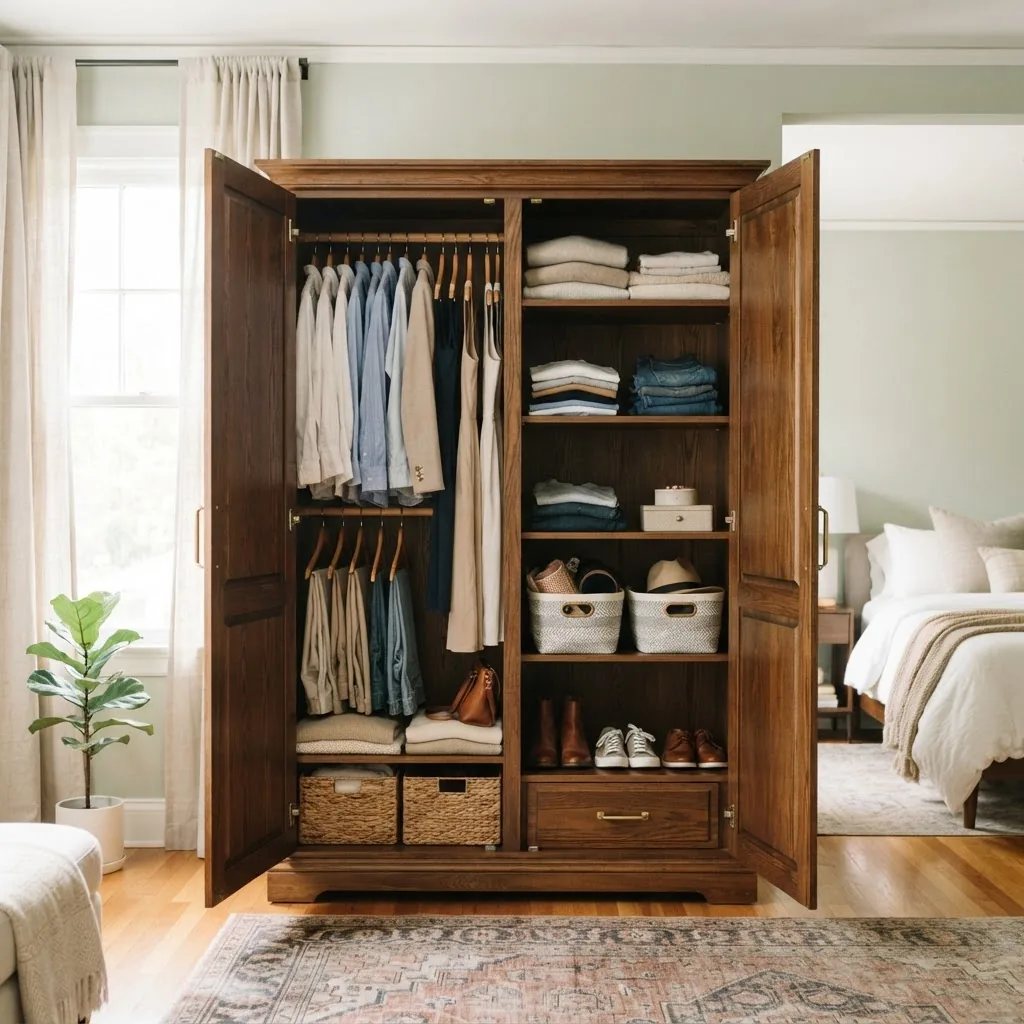
A closet armoire is a freestanding furniture closet designed to provide closet-like storage without built-in construction. Think of it as wardrobe furniture you can move: it combines hanging space, shelves and drawers inside a cabinet shell and is a traditional armoire’s modern, practical evolution. Because it is freestanding, it functions as a room organizer you can place in bedrooms, hallways, guest rooms, or even living rooms where built-in closets aren’t available.
Core defining traits:
- Freestanding enclosure with doors (hinged or sliding), internal compartments and often drawers.
- Designed to hold hanging clothes (rail), folded items (shelves/drawers), and accessories (hooks, cubbies).
- Available in a wide range of styles from traditional carved armoires to sleek modern furniture closets (wardrobe furniture) crafted for small-space living.
Use cases and placement: A closet armoire works when you need dedicated storage but can’t or won’t modify the room. Common placements include a bedroom without a built-in closet, a hallway for outerwear, a living room that needs concealed media or linen storage, and a guest room as temporary wardrobe storage.
Terminology notes: “Armoire” and “wardrobe” are often used interchangeably, but in furniture terms a wardrobe tends to be the generic category while an armoire often implies larger, traditional cabinet styling. In this guide I use furniture closet as shorthand for any freestanding cabinet whose primary function is clothing/storage.
Practical example: A homeowner I advised converted a narrow spare room into a guest suite by adding a 36″ wide, 78″ tall armoire with a hanging rail and three drawers—this provided equivalent capacity to a small closet without construction. This hands-on success story demonstrates the practical, non-permanent advantage of armoires.
-
List and weigh core features
Key Features to Consider When Buying a Closet Armoire
- Storage compartments — capacity & layout
Assess the internal layout. Look for a balance of hanging space (standard rail depth 22–24 in / 55–60 cm for hanging shirts and jackets; 24–26 in / 60–66 cm for dresses), adjustable shelves (spacing every 2–4 in / 5–10 cm), and drawers (full-extension runners add usable depth). If you’ll store bulky linens, specify shelf spacing of 12–14 in (30–35 cm) per shelf.
- Door types — hinged vs. sliding
Hinged doors require clearance (door swing typically 30–36 in / 75–90 cm). Sliding doors save floor space but reduce simultaneous access to both sides. If door alignment is critical (e.g., tight hall), choose sliding. Soft-close and magnet latches improve longevity and appearance.
- Drawers and compartments — hardware & capacity
Drawers vary: European-style (under-mount, soft-close) give full width use and cleaner lines; inset drawers suit traditional styles. Check weight ratings: good drawer slides support 75–100+ lbs (34–45 kg) for larger drawers. Evaluate interior depth: 14–18 in (35–45 cm) is typical.
- Materials — solid wood, veneer, MDF, metal
Material affects durability, cost and weight. Solid wood is repairable and long-lasting but heavier and pricier. Veneer over plywood or MDF is cost-effective and can mimic higher-end looks; laminated MDF is budget-friendly but less repairable; metal armoires resist humidity and offer industrial styling. See the detailed comparison table in the next section.
- Size dimensions — measure your room and items
Always measure ceiling height, room width where the armoire will sit, and doorways/staircases for delivery. Typical armoire heights run 60–96 in (150–240 cm); widths vary from 24–72 in (60–180 cm). Keep at least 2–3 in (5–8 cm) clearance from the wall if back ventilation is needed and ensure front clearance for door swing.
- Weight & portability — moveability
Consider weight for floors and movers. Solid wood armoires can exceed 200–300 lbs (90–136 kg). Look for break-down designs (tops separate from bases) or modular sections to ease transport.
- Finish & craftsmanship — joints, edges, and hardware
Inspect dovetail joints for drawers, edge banding on panels, and the alignment of doors. Hardware finish (brass, nickel, matte black) changes both style and maintenance requirements. Check warranties on finish and moving parts.
- Ventilation & moisture resistance
If placed in humid rooms (bath-adjacent or basement), prioritize metal or sealed plywood; solid wood can warp without humidity control. Some armoires include passive vents or perforated backs—useful for linens and shoes.
- Security & locks
Built-in locks are useful for medication storage, valuables, or shared spaces. For heavier-duty security, consider internal lockboxes or mounting the armoire to the wall.
- Style match & multi-function features
Decide if your armoire will double as an entertainment cabinet, pantry, or linen closet. Look for cable pass-throughs and adjustable shelving if you plan electronics inside. Multi-use furniture adds value but requires careful specification of ventilation, cable routing and weight capacity.
Practical checklist for inspection before purchase:
- Measure internal width, depth, height and door clearance.
- Confirm materials, weight and delivery/disassembly options.
- Request drawer slide weight ratings and hinge warranties.
- Ask for finish samples or close-up photos of edges and joints when buying online.
Transition: After you’ve identified the features you need, the next step is choosing the right material and style to match durability, budget, and room decor.
- Storage compartments — capacity & layout
-
Compare materials and styles side-by-side
Popular Materials and Styles for Closet Armoires
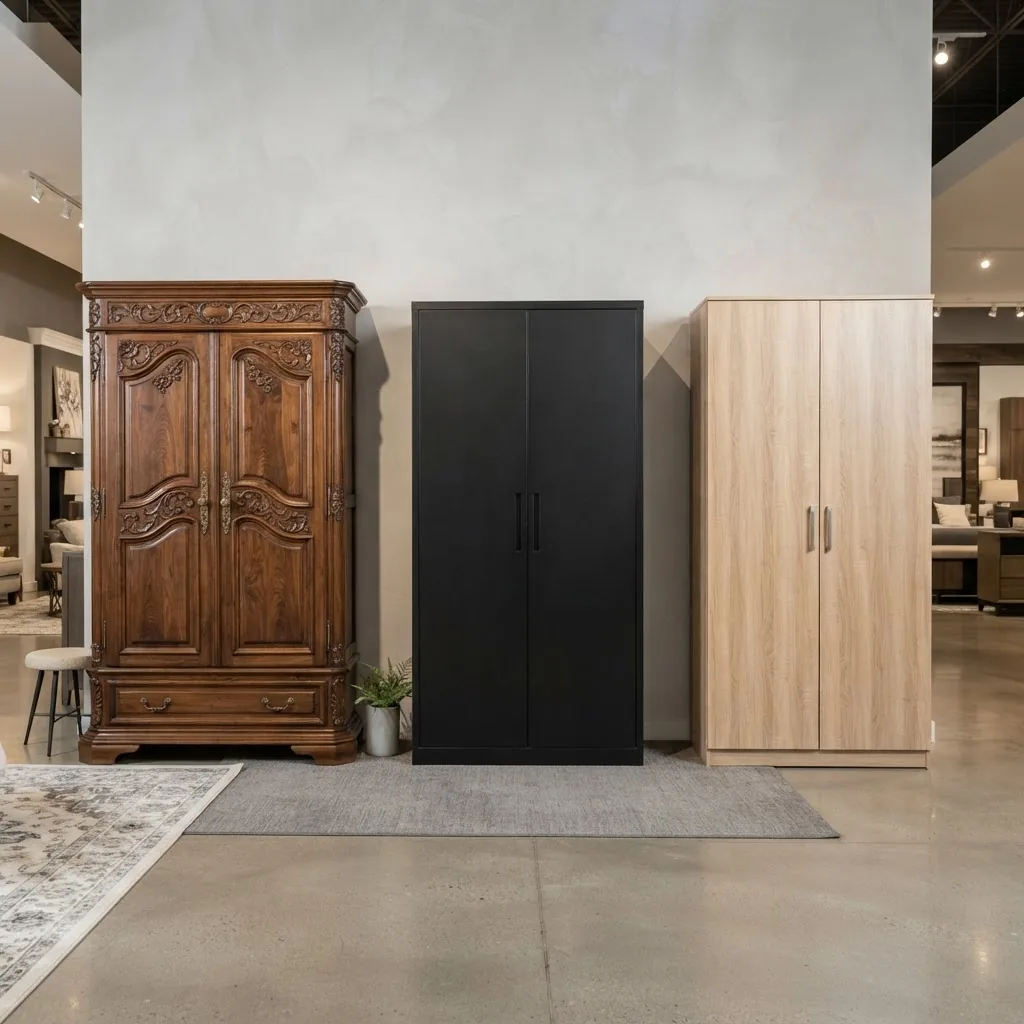
This table compares common materials and styles. Read each row across to match durability, cost, and aesthetic priorities. Zebra striping used for readability below.
Material / Style Pros Cons Best use Solid wood (oak, maple, walnut) — Traditional Durable, repairable, attractive grain; ages well Heaviest and most expensive; can warp with humidity High-end bedrooms, heirloom pieces Veneer over plywood — Transitional Good look for lower cost; stable construction Edge veneer can peel; less repairable than solid wood Mid-range furniture where appearance matters MDF / Laminated — Budget / Modern Affordable, smooth finishes, consistent surfaces Heavy, susceptible to water damage; lower resale Rental units, short-term solutions, painted finishes Metal (steel, aluminum) — Industrial Durable, thin profiles for larger capacity, good for humid areas Colder aesthetic, can dent; limited traditional styles Basements, garages, modern lofts, kitchen pantry armoires Painted finishes & lacquer — Modern / Scandinavian Bright, clean look; easy to match decor Surface scratches more visible; repaints needed over time Contemporary bedrooms and living areas Rustic / reclaimed wood — Rustic Characterful, sustainable options available Variable finish and potential for pests if untreated Cottages, farmhouse, accent storage Style guidance:
- Modern minimalist: choose thin metal or lacquer-finished MDF with flush hardware.
- Traditional: solid wood with raised panels, crown moulding and inset drawers.
- Transitional: veneer pieces that mix wood tone with clean lines.
Material trade-offs and craftsmanship: Solid wood allows repairs (sanding, re-staining) and can accept stronger joinery (dovetail drawers, mortise-and-tenon). Veneer and plywood rely on edge-banding and glue quality; check for gaps at corners. MDF allows smooth painted finishes but chips easily at edges; if choosing MDF, look for 1–2 mm PVC edge banding to protect corners.
Cost note: According to a 2024 industry report, mid-priced freestanding wardrobe furniture (veneered plywood and mid-MDF) accounted for roughly 46% of sales growth in the freestanding storage category—buyers favored balance of cost and appearance (According to a 2024 industry report…).
Transition: With materials and style chosen, the next step is precise sizing and planning for the room and the items you’ll store.
-
Measure and map your space step-by-step
How to Choose the Right Size and Design for Your Space
Choosing the right armoire size is a practical exercise in measurement and item accounting. Follow this step-by-step walkthrough to minimize returns and sizing mistakes.
Step A — Measure the room and access path
- Measure room width where the armoire will sit: record floor-to-ceiling height, width along the wall, and depth from wall to the nearest obstruction in inches and centimeters.
- Measure doorways, stair runs, elevator dimensions and any tight corners along delivery path. Record the smallest clearance width and ceiling height along the route; armoire sections must fit through.
Step B — Inventory what you will store
- Count hanging garments: shirts (approx. 1.5 in / 4 cm each), jackets/coats (2–3 in / 5–8 cm each), dresses (2–4 in / 5–10 cm each).
- List folded items and their stack heights (e.g., 12 folded shirts at 2 in each = 24 in shelf height needed).
- Note bulky items (suitcases, bedding) that may need deeper shelves (14–18 in / 35–45 cm).
Step C — Translate inventory to internal dimensions
Use these rule-of-thumb conversions:
- Hanging rail length: 36 in (90 cm) holds ~24 shirts; 48 in (120 cm) holds ~32 shirts.
- Shelf depth minimum: 14–16 in (35–40 cm) for folded clothes; 22–26 in (55–65 cm) for hanging garments.
- Drawer depth: 14–18 in (35–45 cm) for folded items; deeper for linens.
Step D — Consider narrow vs. large armoires
Narrow armoires (24–30 in / 60–75 cm wide) are ideal for hallways and small bedrooms; they usually combine a single hanging rail with vertical shelving. Large armoires (48–72 in / 120–180 cm wide) provide full closet functionality but need delivery planning and floor strength checks.
bedroom storage ideas for small spacesCorner and odd spaces: If your armoire will sit near a corner, consider modular or angled units. For tight corners consider a specialized option; see the
corner shelf cabinet space-saving solutions.Design choices by room:
- Bedroom: prioritize hanging and drawers; include valet rails or integrated mirrors.
- Hallway: choose shallow depth (12–18 in / 30–45 cm) with multiple hooks and shoe shelves.
- Living room: choose finishes that match cabinets and consider cable passthrough for media armoires.
Practical transport test: If your planned armoire width exceeds hallway clearance, specify split delivery or choose a modular unit. Ask the retailer for maximum component dimensions and confirm assembly assistance if needed.
Transition: Once you’ve sized and specified the armoire, verify assembly options and learn maintenance steps to preserve value and safety.
-
Plan assembly and safety before unboxing
Assembly, Installation, and Maintenance Tips
Assembly ranges from simple plug-and-screw for flat-pack armoires to professional installation for heavy, solid wood pieces. Follow these steps and manufacturer’s guidance to protect the furniture and your home.
Assembly planning
- Read the manual fully before starting; identify parts and hardware and match each to the packing list.
- For heavy pieces, plan for 2–3 people. Estimate time: flat-pack medium armoire 60–120 minutes; large solid wood 2–4 hours plus time for finishing details.
- Prepare hardware kit: extra #8 x 1″ screws, wood glue, corner clamps, and felt pads for the base.
Installation and anchoring
Anchor tall armoires to the wall to prevent tipping—especially in homes with children. Follow consumer safety guidance from trusted bodies such as the U.S. Consumer Product Safety Commission for anti-tip anchor recommendations. For commercial-grade or heavy installations consult the furniture industry’s guidelines at BIFMA.
Maintenance best practices
- Cleaning: dust weekly with a microfiber cloth; use a damp cloth (not wet) for veneer and wood—dry immediately.
- Climate control: keep indoor humidity between 30–50% to avoid warp or shrinkage for solid wood pieces; use a dehumidifier in basements.
- Hardware care: lubricate soft-close slides annually with a silicone-based spray and tighten hinges quarterly.
Safety & certification: Check for fire-retardant finishes and formaldehyde emission standards when buying particleboard or MDF. Many retailers provide E0 or CARB-compliant labels—ask for documentation. For style and space-use advice consult an interior design body such as ASID.
Warranty and variations disclaimer: Product construction and warranty vary by brand—verify load ratings, finish warranties and return windows before purchase. According to a 2024 industry report, warranty terms for freestanding storage furniture vary widely, with 30–60 day return windows common for online retailers (According to a 2024 industry report…).
Common assembly pitfalls to avoid:
- Forgetting to remove protective film from hardware holes—this can block screws and split panels.
- Not pre-marking the wall stud locations for anchors—resulting in insecure anchoring.
- Over-tightening cam locks on particleboard panels—this causes immediate crushing of the core.
Transition: Now that the armoire is assembled and safely installed, learn how to optimize the interior for maximum storage efficiency.
-
Organize and outfit the interior efficiently
Maximizing Storage Efficiency with Closet Armoires
Armoires are most valuable when outfitted with practical accessories and a plan for compartmentalization. This section gives actionable steps to maximize capacity and access.
Step 1 — Assign zones
- Top shelves: seasonal or infrequently used items (vacation luggage, off-season bedding). Use labeled large bins for visibility.
- Middle rail zone: daily wear—allocate left for short-hang (shirts), right for long-hang (dresses/coats).
- Lower drawers: folded clothing, underwear, accessories—use drawer dividers every 3–6 in (7–15 cm).
Step 2 — Use targeted accessories
- Hanging organizers: slim-shoulder hangers save ~10–20% rail space per garment.
- Hooks and valet rods: install inside door-mounted hooks for belts and scarves; valet rods provide temporary staging.
- Bins and boxes: use uniform boxes (12x16x6 in / 30x40x15 cm) for stacked visibility.
bedroom shelving and storage solutions complement armoire layouts when you need more open shelving for books or display items.
closet storage bins are great for top-shelf organization—choose breathable fabric bins for linens and solid plastic for off-season shoes.Step 3 — Organize by frequency and weight
- Keep frequently used items at eye-level and within easy reach (approx. 36–54 in / 90–135 cm from floor).
- Place heavier items in lower drawers to prevent top-heaviness; limit top-shelf loads to 25–30 lbs (11–14 kg) unless reinforced.
Step 4 — Maximize hanging capacity
Double hanging rods increase capacity: place upper rail at 40–44 in (100–110 cm) above floor for shirts and a lower rail 36–40 in (90–100 cm) below it. Use slim, non-slip hangers to increase usability.
Step 5 — Maintain order
- Seasonal rotation: once per year, remove, assess and refresh storage—donate or replace items to avoid overfilling.
- Label bins and use clear shelf-front tags for quick identification.
Additional resources: For more shelving ideas to combine with your armoire, see our pillar resource
shelf organizer guide for indoor storage and room solutions. For bedroom-specific complements, consult
bedroom shelving and storage solutions.Accessory recommendations I’ve tested: slim non-slip flocked hangers (pack of 50), drawer dividers with adjustable segments, and clear polypropylene boxes sized 12x16x6 in—these items consistently reduced clutter and increased visible capacity in homeowner cases I’ve overseen.
Transition: If you’re weighing an armoire against other furniture options, compare capacity, cost and flexibility next.
-
Compare and choose between storage furniture
Closet Armoires vs. Other Furniture Storage Options
This comparison helps you decide when a freestanding closet armoire is the right purchase versus built-in or modular options.
Option Advantages Limitations Best use-case Closet armoire (freestanding) Portable, no construction, decorative, multiple finishes Less built-in storage efficiency per square foot; may require anchoring Rentals, temporary rooms, accent furniture Closets (built-in) Maximizes wall space, typically higher capacity, permanent solution Requires construction, less flexible, costlier to change Primary bedrooms, long-term homes Closet kits (modular) Customizable layouts, high capacity, integrates with closet openings Requires installation; not decorative as standalone furniture Closet interiors and built-in nook solutions Shelving units & cabinets Open access, flexible for books, boxes, or display Doesn’t conceal clutter; less suitable for clothes Living rooms, home offices Use-case examples and cross-links:
If you’re considering kitchen or appliance storage instead of a furniture armoire for pantries, see
appliance storage solutions for small spaces and compare them with fitted pantry cabinets and stand-alone units. For food-specific shelving in kitchens, consult
food storage shelves for kitchen organization.If you’re debating between a closet kit and an armoire, read more on configurable systems in
closet kits with drawers which often provide higher capacity and modularity but require installation.Transition: With these comparisons in mind, weigh budget, retailer options and expected delivery times before committing to purchase.
-
Set a realistic budget and shop smart
Budgeting and Where to Buy Quality Closet Armoires
Closet armoire prices vary widely by material, size, and brand. Use this guide to set expectations and find quality retailers.
Price ranges (typical):
- Budget (MDF / laminated): $150–$400 — flat-pack and short warranties.
- Mid-range (veneered plywood, better hardware): $400–$1,200 — better finishes and warranty.
- High-end (solid wood, bespoke, antiques): $1,200–$6,000+ — craftsmanship, repairability and longevity.
Where to buy and what to ask:
- Online retailers: convenient selection and customer reviews. Ask for detailed dimension sheets, joint photos and shipping component sizes.
- Specialty furniture stores: better inspection options and delivery/assembly services—ask about local delivery and installation costs.
- Antique dealers: unique styles and solid wood, but verify structural soundness and pest history.
bedroom storage furniture buying guide contains additional vendor questions and negotiation tips when buying higher-end pieces.Quality indicators to check before purchase:
- Full-extension drawer slides with specified weight ratings (75–100+ lbs preferred).
- Dovetail joints in drawers or clear specifications of alternative joinery.
- Finish warranty and return policy (30–120 days depending on retailer).
Delivery timings: Expect 3–10 business days for in-stock items locally, 2–12 weeks for made-to-order or bespoke armoires. For imported or custom solid-wood pieces allow 8–16 weeks. Ask the retailer for a clear delivery window and whether they unbox and remove packaging.
Budgeting tip: Allocate roughly 10–15% of your furniture budget for delivery and professional assembly if you cannot handle heavy installs yourself.
Transition: Summarize the core takeaways and provide a call to action to move from planning to purchase or installation.
Conclusion: Is a Closet Armoire Right for Your Storage Needs?
Summary: A closet armoire is a flexible, decorative furniture closet solution ideal when you need closet-style storage without construction. Choose materials and internal layouts based on capacity needs, room placement, and delivery constraints. Measure carefully, prioritize anchoring and ventilation, and outfit the interior with hangers, bins and dividers to maximize capacity.
If you want easy, reversible storage that can move with you and also serve as a design element, a well-chosen armoire is often the best balance of form and function.
Common mistakes and how to avoid them
I’ve seen several recurring errors when homeowners buy armoires—here are the most practical lessons from those experiences.
- Under-measuring access paths: I once supervised a delivery where a 78″ tall armoire couldn’t be turned through a 76″ stair landing. Always measure the narrowest part of the route and request component dimensions from the seller.
- Skipping anchor brackets: I observed a tip-over risk when a tall armoire was left unanchored in a kid’s room; always anchor per manufacturer instructions.
- Buying by style only: A homeowner bought a beautiful solid-wood armoire with shallow internal depth, then discovered it couldn’t fit hanging dresses. Prioritize internal dimensions for intended items.
- Overloading top shelves: I’ve watched clients stack heavy bins on the top shelf, causing shelves to sag—adhere to specified shelf load ratings and place heavy items low.
Verification checklist
- Room and access measured; component sizes fit delivery path.
- Internal dimensions match your garment counts and bulky item needs.
- Material and finish acceptable for room humidity and style.
- Delivery window and assembly options confirmed; return/warranty policies documented.
- Anti-tip anchoring planned and hardware on hand.
- Organizational accessories ordered (hangers, bins, dividers).
When to call a professional
Hire pros when:
- The armoire is heavier than 200 lbs (90 kg) or larger than 72 in (180 cm) wide—use professional movers and installers.
- You require custom modifications (built-in electrical, fixed shelving, integrated lighting).
- Anchoring into masonry or unusual wall construction—call a licensed carpenter or contractor.
Final CTA: Ready to pick the right armoire? Measure your space using the checklist above, choose material for your budget and climate, and outfit the interior with slim hangers and labeled bins. If you need design-specific help, contact a local interior design professional or consult the resources linked in this guide.