


By the end of this mattress buying guide you will have a clear, prioritized checklist and a step-by-step shopping plan that tells you exactly what mattress to test, what to avoid, and how to finalize the purchase. Expect to spend roughly 2–4 hours researching and 1–3 hours trying mattresses (in total), and this guide assumes a basic comfort-savvy consumer level (no prior mattress expertise required).
Before you start
- Tools: tape measure, notebook or phone for notes, measuring tape for bed and room dimensions.
- Documents: list of health considerations (back pain, allergies), budget range, trial period and warranty details for shortlisted models.
- Time blocks: reserve 60–90 minutes if testing in-store, or set aside 30–60 minutes per online model to review specs and reviews.
- Decision helpers: a friend to observe your sleep posture during a trial night or an adjustable bed demo if relevant.
Core steps — step-by-step buying process
- Clarify your primary sleep goals. Write down your top 3 needs (e.g., pressure relief, cooling, edge support) and rank them. If you have chronic back pain, place spinal support above minor preferences like motion transfer.
- Measure your space and bed frame. Measure room clearances and the existing bed frame—width, length and slat spacing. Record exact mattress dimensions required (see mattress size table later) and confirm frame compatibility.
- Set a firm budget range. Choose low, mid, and high price points (e.g., $400, $900, $1,800). Expect entry-level foam/tight-top innerspring around $300–$600, mid-range hybrids $700–$1,500, and premium latex or luxury hybrids $1,500+.
- Shortlist mattress types. Limit to 2–3 types that match your goals (memory foam for pressure relief, hybrid for responsiveness, latex for durability). For deeper technical guidance, consult the types of mattresses guide.
- Define firmness target by sleep position. Based on your dominant position, pick a target on the firmness scale (soft = 2–4, medium = 5–6, firm = 7–8). Use spinal alignment cues described later to fine-tune the choice.
- Check certifications and materials. Verify CertiPUR-US or OEKO-TEX certification for foams and textiles, flame retardant methods used, and whether natural latex is Talalay or Dunlop when durability or allergies matter.
- Compare trial periods and return policies. Prioritize 90-night or longer trial periods and clear return/refund terms. Short, expensive trials often cost more if the mattress doesn’t work out.
- Test in-store, then order online if better value. Try the shortlisted models in-store (30–60 minutes each), then compare online prices, warranties, and return logistics; many shoppers save 20–40% by buying online while using in-store testing to confirm feel.
- Check warranty fine print and expected lifespan. Look for prorated coverage after year one, and specific limits on sagging thresholds (e.g., >1.5″ sag often qualifies as a defect). Expect 7–10 years for foam/hybrid and 10–15 for high-quality latex.
- Plan delivery and setup. Confirm delivery options (white glove vs threshold), mattress-in-a-box vs factory-delivered, and whether returns require pickup or drop-off at a local store.
- Protect and maintain your mattress. Buy a breathable mattress protector, schedule surface cleaning every 3–6 months, and rotate or flip as manufacturer recommends to extend lifespan.
- Reassess after trial and keep documentation. Track sleep quality for at least 30 nights, take photos of sagging or wear, and keep receipts and warranty paperwork handy for claims.
Common mistakes and how to avoid them
I’ve seen buyers choose the softest model because it “felt cozy” in a 10-minute showroom test, then wake sore after two weeks. The better approach: test targeted spinal alignment cues (hips and shoulders alignment) for 15–30 minutes, and always use a 30+ night trial before final judgment.
Another common error I observed: skipping warranty fine print. I learned to always photograph early signs of sagging immediately and file claims within the first 60 days to avoid missing limited windows.
Quick verification checklist
- Measured room and frame dimensions and matched mattress size.
- Ranked top 3 sleep priorities and chosen mattress types accordingly.
- Set a clear budget with low/mid/high targets.
- Confirmed trial length ≥ 90 nights or clear return terms.
- Verified certifications (CertiPUR-US / OEKO-TEX) and warranty details.
- Purchased a breathable mattress protector and noted maintenance plan.
When to call a professional
If you have a specific medical condition (chronic back pain, severe scoliosis, or circulatory problems), consult a licensed physical therapist or physician before selecting a mattress. Call a sleep specialist if pain persists beyond the first 30 nights despite mattress changes.
Transition: With your step-by-step plan in hand, let’s ground the buying decisions with context and detail about mattress types and why each matters.
Introduction to Mattress Buying
The right mattress affects daily energy, pain levels, and long-term spinal health; this mattress buying guide is written to move you from confusion to confident purchase. You’ll learn the mattress buying process in practical terms—how to interpret firmness scales, match a bed to your sleep style, and avoid costly returns. Choosing the right mattress matters because poor support causes micro-awakenings and can increase back and neck pain over months. According to a 2023 National Sleep Foundation report, mattress comfort is a top modifiable factor affecting sleep continuity for many adults; matching priority needs to mattress features raised sleep quality in controlled studies cited by the Foundation.
When you’re planning furniture purchases around your sleep setup, consider complementary pieces. For living room planning or when arranging a small studio, the best couches buying guide and the sofa ideas guide can help you coordinate comfort across the home.
best couches buying guide
sofa ideas guide
different couch styles guide
Transition: now that you understand the impact of your mattress choice, let’s briefly compare the common mattress types so you can shortlist which ones fit your priorities.
Understanding Different Mattress Types — What Are Your Options?
There are four mainstream mattress families to consider: memory foam, innerspring, hybrid, and latex. This section provides a concise comparison so you can decide which family to test first. For a deeper construction and materials breakdown, see the types of mattresses guide.
Short summary by family:
- Memory foam: Excellent pressure relief and contouring; can trap heat unless cooling layers are included.
- Innerspring: Traditional bounce and airflow; edge support varies by coil system.
- Hybrid: Combines coils with foam/latex layers for balance of support and pressure relief.
- Latex: Responsive, durable, naturally cooler, and often better for those avoiding synthetic foams.
| Type | Key benefits | Considerations |
|---|---|---|
| Memory foam | Pressure relief, motion isolation | May retain heat; edge support varies |
| Innerspring | Bounce, airflow, cooler sleep | Less contouring; coil noise possible |
| Hybrid | Balanced support and contouring | Price varies; durability depends on layers |
| Latex | Durable, responsive, cooler | Higher price; natural latex may trigger allergies |
Transition: with mattress families in mind, the next step is to match those options to how you sleep and any health needs you have.
How to Assess Your Mattress Needs Based on Sleep Style and Health
- Side sleepers — prioritize pressure relief. Look for medium to medium-soft feel (approx. 4–6 on the firmness scale). A thicker comfort layer (2–4″ of memory foam or plush latex) reduces shoulder and hip pressure. If you carry more weight at the hips, choose slightly firmer to keep the spine aligned.
- Back sleepers — prioritize spinal alignment. Aim for a medium-firm mattress (5–7). You want lower back support with a surface that allows the pelvis to sink slightly while keeping the lumbar curve supported. Hybrid mattresses with zoned support are effective here.
- Stomach sleepers — prioritize firm, stable support. Choose firmer surfaces (6.5–8) to prevent excessive hip sinking which can increase lumbar extension. Avoid plush top layers thicker than 2″ if you sleep primarily on your stomach.
- Combination sleepers — prioritize responsiveness. If you change positions frequently, a medium to medium-firm responsive surface is best. Latex and some hybrid constructions provide quick rebound for easy turning.
- Mattress for back pain — look for targeted support. For lower back pain, choose models with zoned support, medium-firm overall feel, and proven pressure relief. According to a 2022 clinical review in a sleep medicine journal, medium-firm mattresses often reduce pain better than very soft surfaces.
- Allergies and mattresses — choose materials wisely. Hypoallergenic covers, natural latex or tightly woven fabrics, and certified low-VOC foams (CertiPUR-US) reduce irritants. For severe allergies, prefer encasements and washable covers.
- Sleep partners — prioritize motion isolation and edge support. If sharing a bed, prioritize memory foam or well-designed hybrids with individually wrapped coils and strong edge support to increase usable sleep surface and minimize partner disturbance.
- Temperature regulation — choose cooling features. If you sleep hot, prioritize breathable covers, cooling gel foams, open-cell latex, or innersprings with airflow channels. Phase-change or copper-infused layers can help but are secondary to overall construction.
Transition: once you understand how sleep position and health shape needs, refine selection by focusing on firmness and support trade-offs.
Mattress Firmness and Support – Finding the Right Balance

Firmness and support are distinct: firmness describes the initial feel (surface resistance) and is commonly rated 1–10; support describes how well the mattress maintains spinal alignment under load. Follow these how-to steps to find the balance your body needs.
- Use a firmness target as a starting point. Map your target: soft (2–4), medium (5–6), firm (7–8). Remember this is a guideline—manufacturers’ labeling varies.
- Perform the 2-minute spinal check in-store. Lie on your back and have a friend observe whether your lower back has a slight inward curve. If the lumbar area shows a deep gap, you need firmer support; if there’s visible compression, a softer surface may help.
- Test pressure points for 90 seconds on each side. For side sleepers, press into the shoulder/hip area and note if the pressure is relieved or concentrated. Good pressure relief should reduce peak contact pressure noticeably.
- Assess responsiveness for combination sleepers. Press the surface and time rebound with your hand; fast rebound (latex-like) helps repositioning, slow rebound (memory foam) aids pressure relief but can hinder turning.
- Example scenarios:
- Light side sleeper (under 140 lb): soft-medium (3–5) often works.
- Average back sleeper (140–200 lb): medium-firm (5–7) provides alignment.
- Heavier sleeper (200+ lb): firmer construction and thicker support layers (7–10) to avoid bottoming out.
- Use pressure mapping cues (if available). Some stores offer pressure-mapping demos that visually show high-pressure zones; use them when possible to pick models that minimize red zones in the shoulder and hip areas.
Transition: once firmness and support targets are clear, confirm mattress size and bed-frame compatibility next.
Choosing the Right Mattress Size and Dimensions
Choose mattress size based on sleeper count, bedroom dimensions and how much space you need to move. Measure room width, allow at least 24″ clearance on either side when possible, and confirm bed frame compatibility (slatted base, platform, adjustable base, or box spring).
| Size | Dimensions (W × L) | Best for |
|---|---|---|
| Twin | 38″ × 75″ | Children or small guest rooms |
| Full | 54″ × 75″ | Single adult who wants extra width |
| Queen | 60″ × 80″ | Most couples and master bedrooms |
| King | 76″ × 80″ | Couples who want maximum personal space |
| California King | 72″ × 84″ | Taller sleepers who need length |
If you’re coordinating more furniture or planning a studio layout, compare sizing principles to sofa planning: see the Couch Dimensions Guide for Choosing the Perfect Sofa Size to align circulation, clearances and scaling across pieces.
Couch Dimensions Guide for Choosing the Perfect Sofa Size
Transition: size picked? Next is how much you should plan to spend and where to save without sacrificing key features.
Budgeting Your Mattress Purchase — What to Expect and Where to Save
Set realistic expectations by price tier:
- Budget ($300–$700): Basic foam or innerspring; acceptable for guest rooms or short-term use. Save by choosing fewer comfort layers and focus on warranty clarity.
- Mid-range ($700–$1,500): Good balance of materials and durability; hybrids and better foams live here—best value for most buyers.
- Premium ($1,500+): Natural latex, advanced zoning, and luxury hybrids. Expect longer warranties and higher durability, but with diminishing returns beyond comfort preference.
Where to save:
- Buy during sale windows (Memorial Day, Labor Day) to save 15–40%.
- Prioritize structural components over decorative covers; solid support layers matter more than quilting.
- Use coupon stacking for online purchases and verify return logistics to avoid surprise restocking fees.
Transition: With budget and size in place, here’s how to shop effectively—both in-store and online—so you make a confident final purchase.
How to Shop for a Mattress — In-Store vs Online Buying Tips

This section walks through the exact shopping routine I use with clients: test key models in person, compare pricing and policies online, and decide based on trial logistics and warranties. For a post-selection look at brands, consult the mattress brands guide after you narrow types.
- Prepare a shortlist of 3–5 models. Use your sleep goals and budget to pick models across your target types. Note firmness, materials, trial length, warranty, and price per size.
- Test in-store using the 30/30/30 rule. Spend 30 minutes lying in your primary position, 30 minutes in other positions, 30 seconds evaluating edge support and roll-off. Bring typical sleep clothing to mimic home conditions.
- Ask targeted questions. Confirm coil counts vs coil type, foam density, topper thickness, and whether covers are removable and washable. Ask for demonstration of edge support and motion transfer tests if available.
- Compare online offers thoroughly. Check final price(s), shipping cost, trial period, return pickup policy, and warranty exclusions. Online savings often offset in-store convenience, but ensure the return logistics are clear.
- Pros and cons — in-store vs online:
- In-store pros: immediate feel, ability to test responses and edge, instant takeaways for in-person deals.
- In-store cons: shorter test time per mattress, sales pressure, sometimes higher prices.
- Online pros: longer trials, lower prices, home convenience, free returns on many brands.
- Online cons: delayed gratification, return logistics, potential difficulty with very firm or heavy models during returns.
- Finalize with trial logistics in mind. Prefer vendors with at least 90 nights and free return pickup. Keep documentation of mattress condition and photos if you plan to file warranty claims later.
Transition: before you buy, run the key features checklist below to confirm you’re not missing crucial durability, safety or comfort signals.
What to Look for When Buying a Mattress — Key Features Checklist
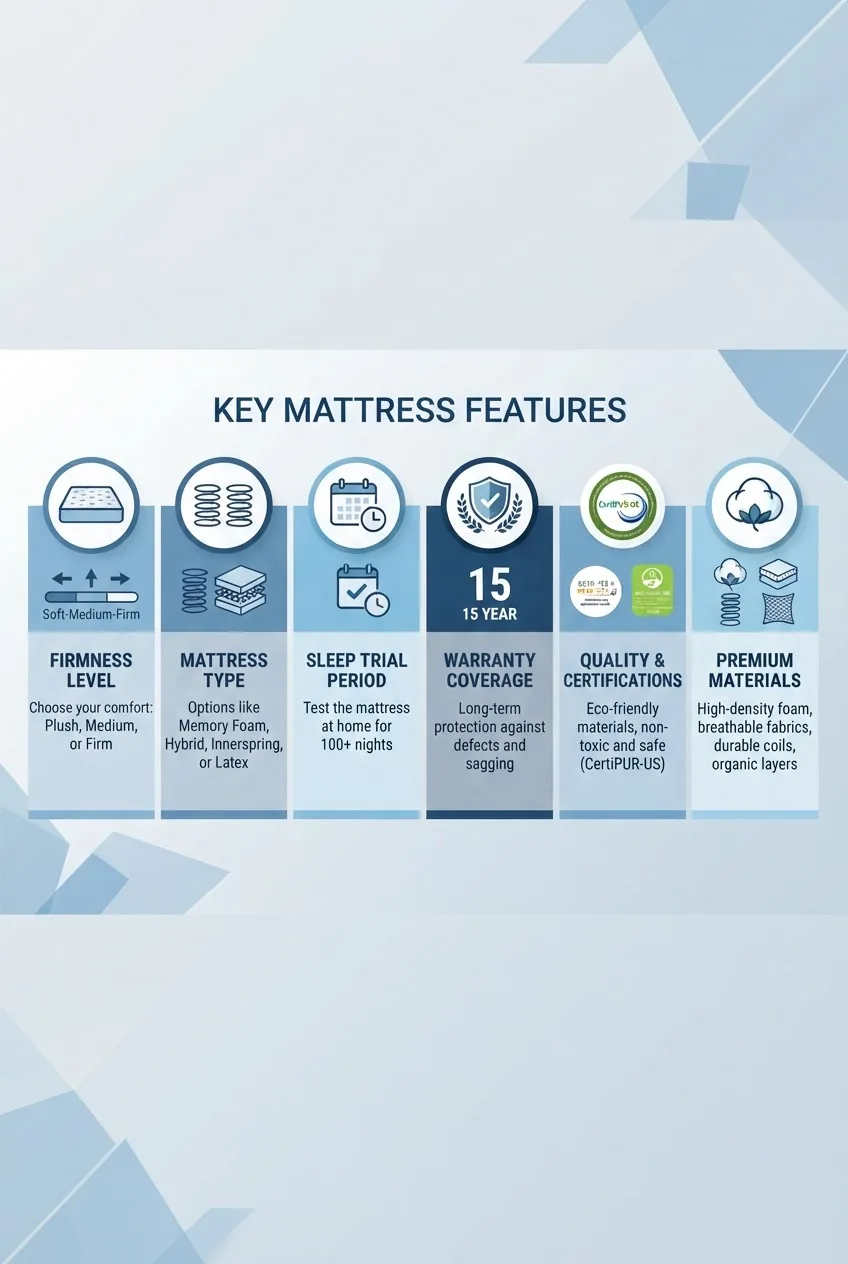
Use this checklist to validate final choices. Each item below is actionable—check the box only when you can point to an exact spec or policy.
- Firmness rating listed (1–10) — Confirm numerical rating and try to match it to your target; don’t rely on vague labels like “plush” alone.
- Type and layer specs — Note comfort layer materials and thickness (e.g., 3″ memory foam over 8″ pocketed coils).
- Trial period length — Prefer 90+ nights and verify the guarantee starts on delivery date, not ship date.
- Warranty details — Check defect definitions (e.g., sagging >1.5″), prorated terms, and claim submission windows.
- Certifications — Look for CertiPUR-US or OEKO-TEX for materials and low-VOC assurance.
- Durability expectations — Confirm expected lifespan (years) and recommended rotation schedule from the maker.
- Noise and motion transfer data — Especially for coil systems; ask for demonstration.
- Edge support strength — Ensure the bed supports sitting and sleeping near edges without excessive sinkage.
- Return logistics — Free pickup versus customer drop-off; restocking fees; time to refund.
Transition: after purchase, simple maintenance extends the mattress life; follow these practitioner-tested steps.
Caring for Your Mattress to Extend Lifespan and Maintain Comfort
- Use a breathable mattress protector immediately. Protect from spills and allergens; wash protector every 2–3 months.
- Rotate (not flip) every 3 months for the first year. If the manufacturer permits flipping, do so at month 3 and 9. For one-sided models, rotate head-to-foot to even wear.
- Spot-clean spills within 24 hours. Use mild detergent, blot (don’t saturate), and air-dry fully to prevent mildew.
- Air out mattress quarterly. Remove bedding for 2–4 hours with windows open to reduce trapped moisture and odors.
- Address sagging early. Photograph and measure sag depth; if it exceeds 1.5″ within warranty, file a claim with photos and purchase documentation.
- Vacuum surface every 3–6 months. Use a soft upholstery attachment to remove dust, hair and allergen buildup.
Transition: finally, here are answers to common buyer questions to speed decision-making.