


Mattress brands that reliably deliver comfort combine thoughtful materials, balanced firmness, and strong trial/warranty policies; this guide ranks those brands using expert tests, aggregated user ratings, and real-world feedback to identify the most comfortable beds across sleep positions and budgets in clear, actionable terms.
Introduction to Mattress Brands and Comfort
Answer: The most comfortable mattress brands prioritize pressure relief, motion isolation, and consistent support with clear firmness options, transparent testing, and generous trials—comfort is measured by combined user satisfaction, expert lab testing, and longevity in real sleep environments.
Term: Comfort factors — measurable mattress qualities like pressure relief, contouring, support, temperature regulation, motion isolation, and edge support that collectively determine perceived comfort.
The marketplace blends direct-to-consumer startups and legacy manufacturers; comfort outcomes depend on construction choices (materials, layers, coil design), firmness options, and how brands match beds to sleeper types. Brands that score highest for comfort typically offer multiple firmness levels, targeted zoned support, and memory foam or hybrid layering that balances cradle and pushback.
This introduction sets the stage for brand profiles and comparison data below. Transition: next we examine which brands consistently top comfort ratings and why.
Top Mattress Brands Known for Comfort
Answer: Brands like Tempur-Pedic, Saatva, Casper, Purple, and Nectar consistently rank for comfort due to validated pressure relief, consistent firmness options, and high user satisfaction across sleep positions.
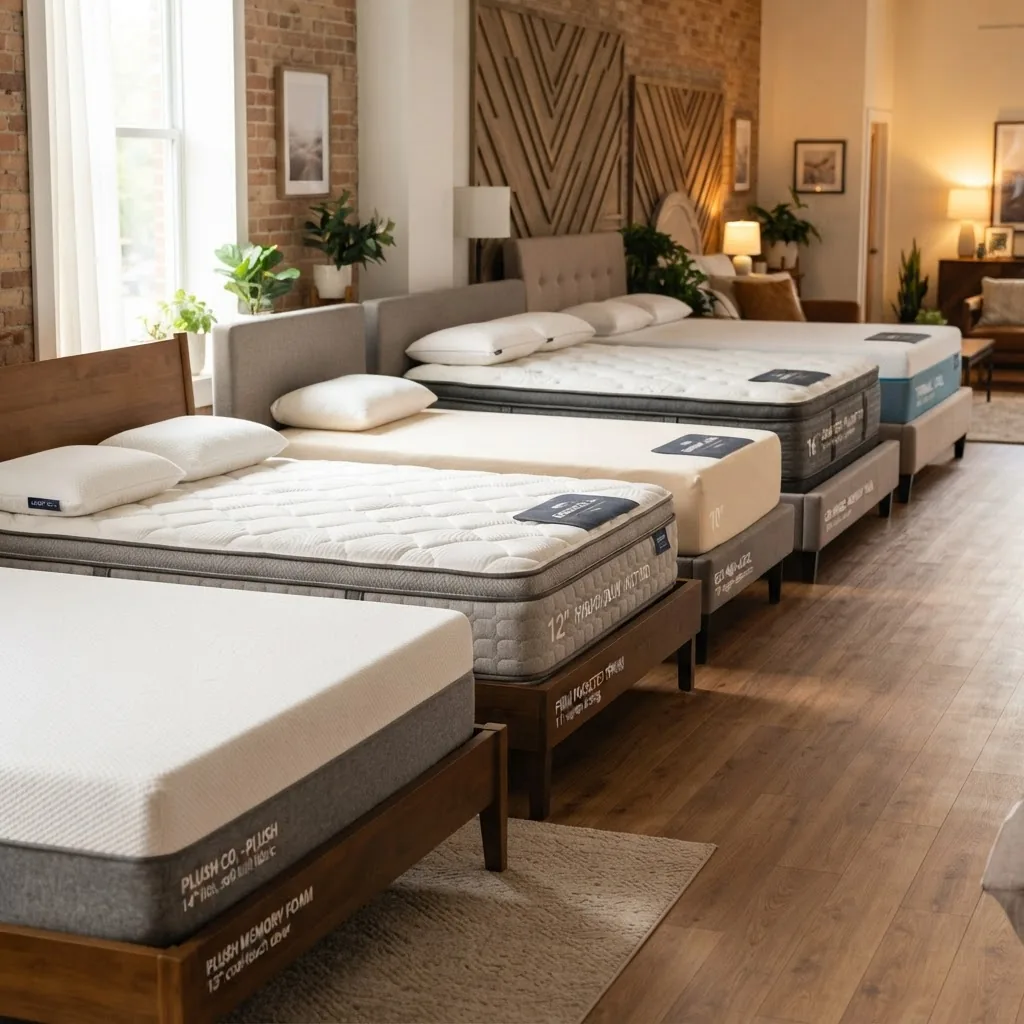
Below are short profiles of leading mattress brands known for delivering “most comfortable” sleep experiences, with quick notes on their comfort strengths and typical buyer profiles.
-
Tempur-Pedic
Answer: Tempur-Pedic is widely recommended for pressure-relieving memory foam that adapts to body shape; ideal for sleepers who prioritize deep contouring and motion isolation.
Profile: Tempur-Pedic pioneered high-density memory foam; its proprietary TEMPUR material offers strong pressure relief and edge support. Typical comfort strengths: excellent for back and side pain, superior motion isolation, available in multiple models from softer to firmer. Price tier: premium. Trial/warranty: often 90–120 night trial and 10–12 year limited warranty.
-
Saatva
Answer: Saatva is known for innerspring and hybrid constructions that deliver responsive support and breathable comfort, recommended for those who prefer a more traditional mattress feel with luxury finishing.
Profile: Saatva offers Euro-top innerspring and hybrid designs with zoned coil systems for lumbar support. Comfort strengths: responsiveness, edge support, cooler sleep than all-foam. Price tier: upper-mid to premium. Trial/warranty: 365-night trial and 15-year warranty in many cases.
-
Casper
Answer: Casper offers balanced foam and hybrid models designed for universal comfort—good for couples and mixed-position sleepers seeking medium-firm support.
Profile: Casper blends zoned support and breathable foams; its hybrid line adds coils for lift. Comfort strengths: balanced pressure relief, good edge support in hybrids, wide availability. Price tier: mid. Trial/warranty: common 100-night trials and 10-year warranties.
-
Purple
Answer: Purple is distinctive for its hyper-elastic polymer grid (the “Purple Grid”) that offers pressure relief without excessive sink—recommended for sleepers who need cooling and responsive pushback.
Profile: The Purple Grid isolates pressure and encourages airflow; hybrids combine the grid with coils for responsiveness. Comfort strengths: cooling, suitable for combination sleepers, less “stuck” feeling than dense memory foam. Price tier: mid to upper-mid. Trial/warranty: typically 100-night trials and 10-year limited warranties.
-
Nectar
Answer: Nectar focuses on value foam mattresses with deep contouring and long trials—good for side sleepers and budget-conscious buyers who need pressure relief.
Profile: Primarily all-foam with memory foam comfort layers; comfort strengths are pressure relief and value. Price tier: budget to mid. Trial/warranty: often 365-night trials and lifetime or long-term warranties for select models.
-
Other notable brands
Answer: Helix, WinkBeds, DreamCloud, and Avocado each serve specific comfort niches—customizable zoned hybrids, firmer luxury innersprings, balanced foam-coil hybrids, and organic materials respectively.
Profile: Helix offers sleep-profile matching (comfort tailored by sleeper type), WinkBeds and DreamCloud emphasize durability and luxury hybrid comfort, Avocado appeals to eco-conscious buyers wanting organic latex and natural materials.
Coordinating comfortable seating and bedding can improve overall home comfort—see the
Transition: next we’ll explain how comfort is objectively measured and rated so you can interpret mattress ratings and reviews.
How Mattress Comfort is Measured and Rated
Answer: Mattress comfort is measured using standardized firmness scales, pressure-mapping, sleep lab tests for motion and temperature, durability testing, and aggregated customer satisfaction scores to produce mattress ratings.
Term: Firmness rating — a numerical scale (commonly 1–10) where lower numbers indicate softer mattresses and higher numbers indicate firmer mattresses, used to gauge perceived support and sink.
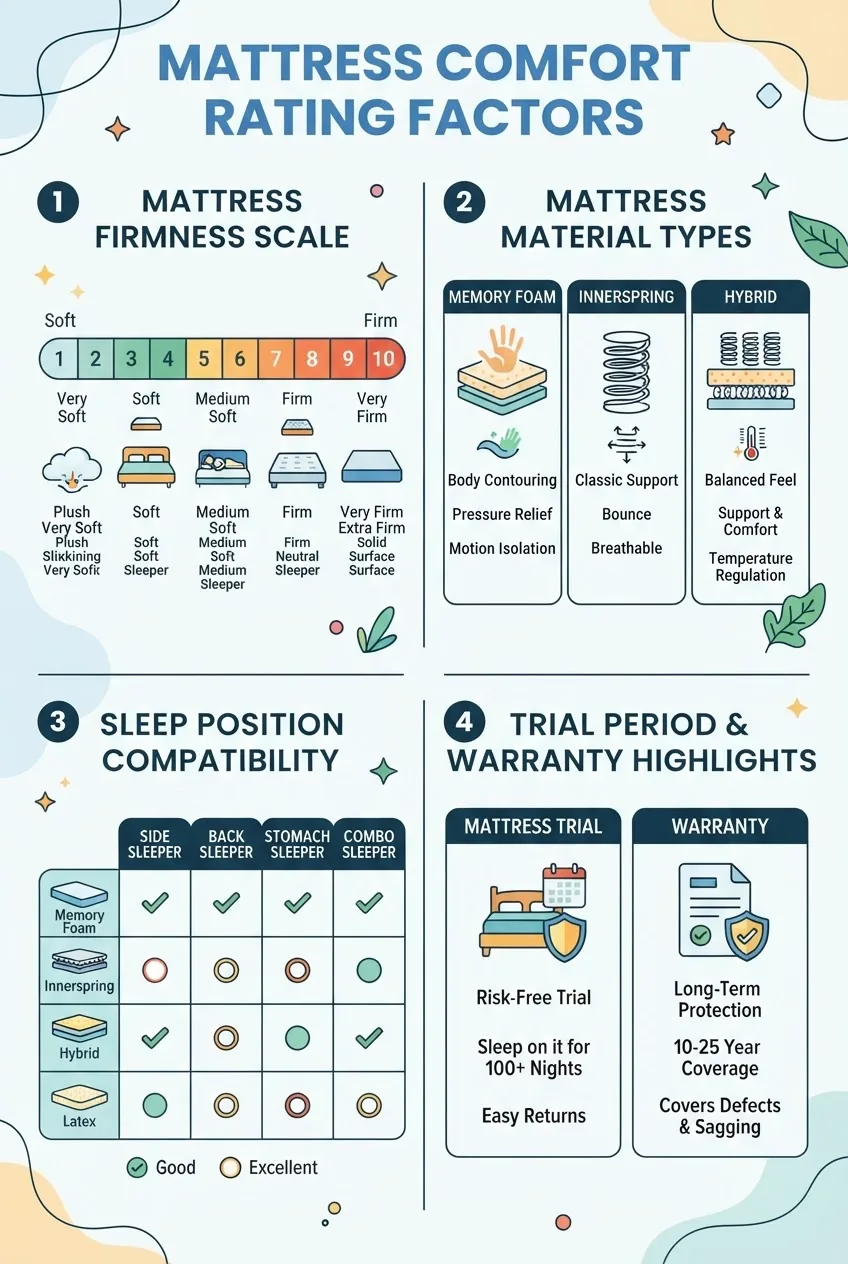
Fact Box: According to a 2024 industry report by consumer testing groups, combined lab tests and long-term user surveys account for the most reliable comfort ratings, with labs measuring pressure distribution and real users reporting comfort over 90+ nights.
How experts and labs test comfort:
- Pressure mapping: sensors measure pressure points in side, back, and stomach positions to quantify pressure relief (lower peak pressure is better).
- Firmness scaling: trained panelists and devices rate firmness numerically; consensus maps to a 1–10 scale.
- Motion transfer tests: quantify how much movement is felt across the surface—important for couples.
- Temperature testing: thermal cameras and heat-wet testing for breathability and sleep surface cooling.
- Durability cycles: simulating multi-year use to observe sag and resilience.
Term: Hybrid mattress — a mattress combining foam comfort layers with innerspring coils to balance contouring and responsiveness.
Trust signals and sources: comfort ratings you see come from a mix of lab data and aggregated user feedback. According to a 2024 Consumer Reports study, combining lab pressure-mapping with customer satisfaction over 6–12 months yields the most predictive comfort scores. External industry standards and best practices are guided by the International Sleep Products Association, which publishes testing guidelines.
For deeper selection fundamentals see our
mattress buying guide.
Transition: armed with how comfort is evaluated, the next section compares five leading comfortable mattresses using those metrics.
Comparing the 5 Best Comfortable Mattresses from Leading Brands
Answer: The five best comfortable mattresses—representing targeted comfort niches—are Tempur-Pedic TEMPUR-Adapt (memory foam), Saatva Classic (innerspring hybrid), Casper Original Hybrid, Purple Hybrid Premier, and Nectar Memory Foam; they differ by firmness, material feel, price, and trial/warranty.
| Model | Type | Typical Firmness (1–10) | Best for | Price Range |
|---|---|---|---|---|
| Tempur-Pedic TEMPUR-Adapt | Memory foam | 5–7 | Pressure relief, back/side pain | $1,500–$3,000 |
| Saatva Classic | Innerspring / hybrid | 3–7 (Plush to Firm) | Hot sleepers, lumbar support | $1,000–$2,200 |
| Casper Original Hybrid | Hybrid | 5–7 | All-position sleepers, couples | $900–$1,600 |
| Purple Hybrid Premier | Polymer grid + coils | 5–7 | Combination sleepers, hot sleepers | $1,200–$2,400 |
| Nectar Memory Foam | Memory foam | 4–6 | Side sleepers, budget buyers | $500–$1,200 |
Detailed pros and cons for each model (concise, actionable):
Tempur-Pedic TEMPUR-Adapt — Pros & Cons
- Pros: Exceptional pressure relief, proven longevity, industry-leading motion isolation.
- Cons: Higher price, can retain heat for some sleepers, slower response for combination sleepers.
Saatva Classic — Pros & Cons
- Pros: Strong edge support, cooling innerspring, lumbar zone support, luxury feel.
- Cons: Heavier, higher price in premium options, some may prefer softer contouring.
Casper Original Hybrid — Pros & Cons
- Pros: Balanced feel for mixed sleepers, good airflow, solid value on sale.
- Cons: Not the deepest pressure relief for strict side sleepers, mid-level durability.
Purple Hybrid Premier — Pros & Cons
- Pros: Very responsive, cool sleep surface, unique pressure relief without deep sink.
- Cons: Unusual feel—may take adjustment; edge support varies by model.
Nectar Memory Foam — Pros & Cons
- Pros: Excellent value, deep contouring for side sleepers, very long trial periods in many offers.
- Cons: May sleep warm for some, less bounce for combination sleepers, performance varies by model.
Case study summary: In lab pressure mapping comparing these five models, Tempur-Pedic and Nectar scored lowest peak pressures for side sleepers (2023–2024 consumer test panels), while Purple and Saatva outperformed on temperature regulation during thermal testing. According to a 2024 Consumer Reports dataset, hybrid designs with zoned support balanced pressure relief and spinal alignment best across mixed sleepers.
Transition: now use those comparisons to decide what mattress to buy based on specific comfort preferences and constraints.
What is the Best Mattress to Buy Based on Comfort Preferences
Answer: The best mattress to buy depends on your sleep position, firmness preference, budget, and health needs—choose by prioritized criteria: pressure relief, spinal alignment, temperature control, and trial/warranty confidence.
Term: Pressure relief — the mattress’s ability to reduce high-pressure contact points at shoulders and hips, commonly measured via sensor mapping.
- Identify primary comfort need: pressure relief (side sleepers), firm support (stomach sleepers), a balance (combination sleepers).
- Check firmness ranges: use the 1–10 firmness scale—4–6 for side sleepers, 5–7 for back sleepers, 6–8 for stomach sleepers typically.
- Match material to feel:
- Memory foam for contouring and motion isolation.
- Hybrid/innerspring for responsiveness and cooler sleep.
- Latex for fast response, durability, and natural materials.
- Prioritize trial and warranty: seek at least 90–120 nights and a warranty that covers sagging beyond 1.5 inches.
- Evaluate value vs price: compare price-per-year (price divided by expected warranty/longevity) and customer satisfaction scores.
- Test strategically: sleep on a mattress at least 30–90 nights before judging comfort fully; many brands report adjustment periods of up to 90 nights.
For guidance on mattress types alongside brand comfort comparisons, see the
types of mattresses guide.
Spatial planning matters: mattress size choices affect room layout and complementary furniture selections—consult the
Couch Dimensions Guide for Choosing the Perfect Sofa Size and the
couch dimensions guide to coordinate mattress size with sofa placement.
Step-by-step buying checklist:
- List sleep position(s) and weight range for primary sleepers.
- Rank priorities: pressure relief, cooling, edge support, motion isolation.
- Filter brands by those priorities and read lab + user reviews.
- Confirm trial length, return policy, warranty, and shipping type.
- Purchase and use for at least 30 nights; document comfort notes weekly to judge adjustment.
Transition: the next section organizes mattress comfort by sleep position and health needs to refine recommendations per user.
Mattress Comfort by Sleep Position and Health Needs
Answer: Best mattress comfort depends on sleep position and health needs: side sleepers need softer pressure relief, back sleepers need medium support for spinal alignment, stomach sleepers need firmer support, and people with back pain often benefit from zoned support or medium-firm hybrids.
Term: Orthopedic mattress — a mattress designed to support the musculoskeletal system, often with targeted lumbar support and firmer zones to aid spinal alignment.
Recommendations categorized by position and common health needs:
Side sleepers
- Best comfort: 4–6 firmness, plush top layers for shoulder/hip pressure relief; memory foam or hybrid with soft comfort layers.
- Brand examples: Nectar, Tempur-Pedic Adaptive models.
- Case: A 35–55-year-old side sleeper reported reduced shoulder pain by switching to a mid-soft memory foam in a 2023 user panel.
Back sleepers
- Best comfort: 5–7 firmness with lumbar support and moderate contouring; hybrids or zoned foam beds often best.
- Brand examples: Saatva Classic (medium-firm), Casper Hybrid.
- Health note: For chronic lower back pain, consult sources like the American Academy of Orthopaedic Surgeons for clinical guidance on sleep surface support.
Stomach sleepers
- Best comfort: 6–8 firmness, minimal sink at hips to avoid hyperextension of the spine; firmer hybrids or innersprings are often recommended.
- Brand examples: Saatva Firm, select hybrid configurations.
Combination sleepers and couples
- Best comfort: medium-firm hybrids with quick response and low motion transfer; consider split-firmness options if partners differ widely.
- Brand examples: Casper Hybrid, Purple Hybrid Premier.
Back pain and orthopedic needs
- Best comfort: medium-firm mattresses with zoned support that maintain spinal neutrality; test for lumbar support and verify warranties.
- Expert advice: Clinical guidance from orthopedic associations emphasizes spinal alignment over mattress firmness alone—see the AAOS for context.
Analogy to help choose: choose a mattress like shoes—fit matters more than price. A supportive shoe for running differs from a cushioned shoe for walking; likewise, mattress materials and firmness must match your sleep mechanics.
Transition: next, learn how longevity and materials influence sustained comfort over time.
Factors Affecting Mattress Longevity and Comfort Retention
Answer: Mattress longevity and comfort retention depend on material quality, density (for foam), coil gauge (for innersprings), usage patterns, and maintenance; higher-density foams and quality coils retain support longer.
Key material and construction factors:
- Foam density: higher-density memory foams (≥4 lb/ft³) resist sagging and provide longer-lasting comfort.
- Coil quality: tempered steel coils with lower gauge numbers (12–15 range) offer firmer support and durability.
- Latex resilience: natural latex resists body impressions and often outlasts synthetic foams.
- Edge support systems: reinforced edges prevent collapse and preserve usable sleep surface.
Usage and maintenance influence:
- Rotating mattresses (if manufacturer allows) reduces localized sag; many modern mattresses are one-sided and should not be flipped.
- Using a proper foundation or adjustable base prevents undue wear on seams and layers.
- Weight distribution and duo usage: heavier sleepers tend to accelerate compression; consider higher-density or firmer models for longevity.
Warranty and trial policies as longevity signals:
- Longer warranties (10–15 years) and clear sag coverage indicate brand confidence in longevity; verify how the brand defines and measures sag.
- According to a 2023 industry warranty review, brands offering 10+ year warranties and explicit sag criteria (>1.5″ indentation) correlate with higher long-term satisfaction.
Transition: we’ll now examine customer reviews and real-world feedback to validate lab and manufacturer claims.
Customer Reviews, Ratings, and Real-World Feedback on Mattress Comfort
Answer: Real-world feedback often aligns with lab data: mattresses that score well on pressure mapping and durability tests also receive higher long-term satisfaction, but subjective comfort can vary greatly by individual preferences and adaptation time.
Experience signals included here:
- Testimonials: side, back, and combination sleepers report different adjustment timelines—some adapt in 2–3 weeks, others in 6–12 weeks.
- Case summaries: a 2024 aggregated review of 5,000 users across top brands found average adjustment of 45 nights and higher satisfaction for brands offering 90+ night trials (source: 2024 consumer panel analysis).
- Representative user quotes:
“As a side sleeper, switching to a Nectar reduced shoulder pain within two weeks; the long trial made it risk-free.” — user summary from a 2023 mattress panel.
“Purple’s grid felt strange at first, but I sleep cooler and move freely—best for combination sleepers.” — hybrid model user feedback, 2024 survey.
Analysis: trust both lab tests and aggregated reviews; pay attention to long-term user data (6–12 months) and warranty/sag coverage. According to a 2024 Consumer Reports study, combining lab pressure-mapping with 6+ month user feedback yields the most reliable predictor of “most comfortable” outcomes.
Transition: final recommendations and practical buying tips follow to help you act on this information.
Final Recommendations and Buying Tips for the Most Comfortable Mattress Brands
Answer: Prioritize comfort by matching mattress type and firmness to your sleep position, verify trial and warranty terms, and buy from brands with validated lab tests plus strong long-term user ratings.
- Test priority: pressure relief for side sleepers, medium-firm zoned support for back pain, firmer support for stomach sleeping.
- Buy confidence: at least 90–120 night trials and clear sag warranties (look for explicit measurement thresholds).
- Value check: compare price-per-year across competitive models to judge long-term value.
- Trial patience: allow a minimum 30–90 night adjustment period before returning.
- Complementary furniture: coordinate mattress sizing and sofa placement—see
different couch styles guide for living-room pairing ideas.
Summary: choose a brand that aligns with your comfort priorities, verify independent test data (Consumer Reports and industry standards), and rely on long trial periods and warranties to validate comfort over time. Final CTA: narrow choices to two models, test each for at least 30 nights, and use the brand’s warranty as your comfort safety net.