


Types of mattresses fall into clear categories—innerspring, memory foam, latex, hybrid, air and waterbeds—each differing in construction, support, pressure relief, temperature behavior and lifespan; knowing the mattress kind you need narrows options and prepares you to compare firmness, materials and health considerations effectively in later buying steps.
Overview of Different Types of Mattresses?
Answer: The main mattress categories are innerspring, memory foam, latex, hybrid, air and waterbeds; each kind uses different core materials and comfort layers that change support, pressure relief, breathability and expected durability.
Term: Mattress type means the primary construction or core material that determines a mattress’s support system and performance (for example, coils versus foam).
This section summarizes how mattress classifications and mattress kinds differ so you can match the category to sleep needs before diving into brand or size decisions. We’ll define each kind, explain core components like coil types and foam density, and flag where they typically perform best (pressure relief, breathability, motion isolation).
Across types you’ll evaluate: support and pressure relief (how the mattress maintains spinal alignment and reduces point pressure), breathability and temperature regulation (how heat is moved away from the body), durability and lifespan, and motion isolation (how movement transfers between sleepers).
According to a 2023 Consumer Reports mattress review, consumer satisfaction varies by mattress kind and firmness; matching type to sleep position and body weight is often the biggest predictor of long-term comfort (source cited later in type-specific sections).
Transition: The most traditional category is innerspring—learn how coils shape support and why many sleepers still choose them.
Innerspring Mattresses?
Answer: Innerspring mattresses use metal coils as the primary support system and are known for bounce, edge support and strong airflow; coil type and gauge determine responsiveness, support and durability.
Term: Coil mattresses (another name for innerspring) refer to mattresses with metal springs—examples include Bonnell, offset, continuous and pocketed coils.
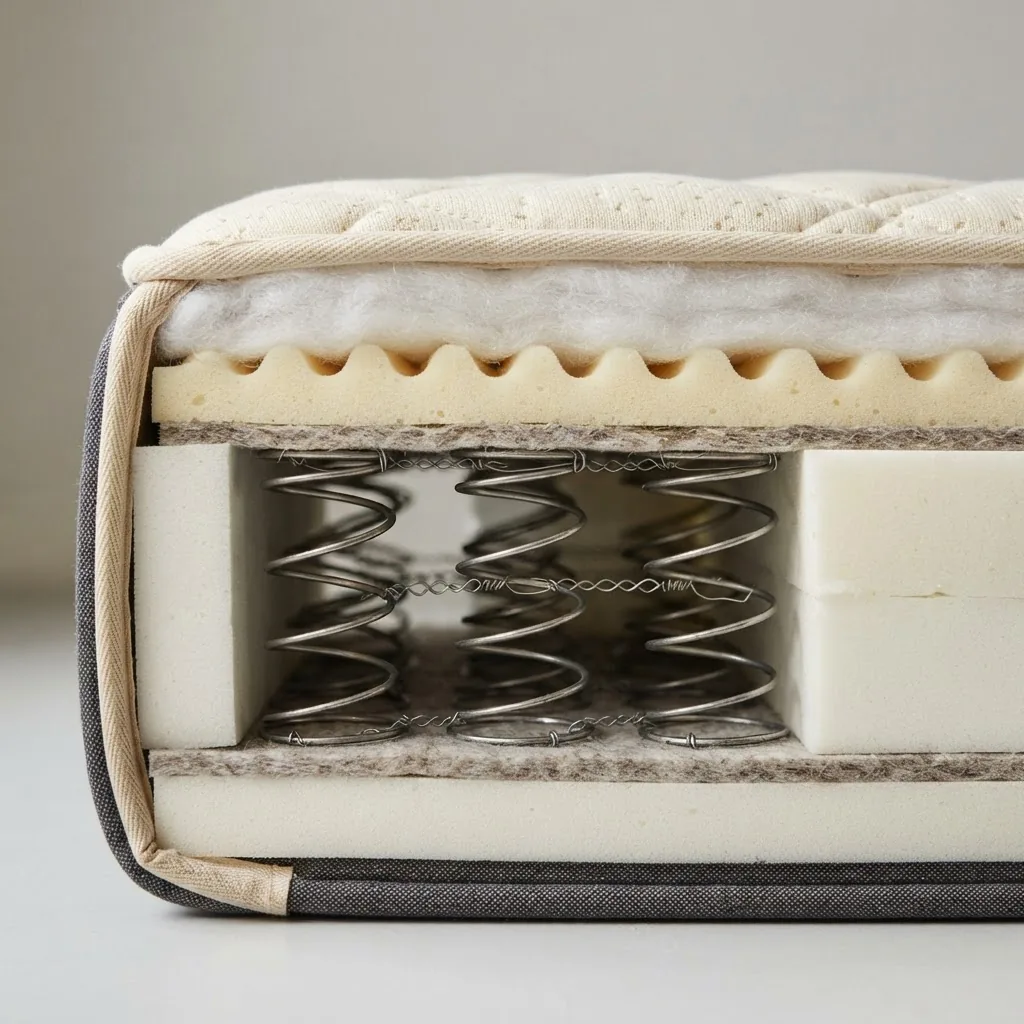
Construction details: innerspring mattresses pair a coil unit (the support core) with top padding layers—polyfoam, latex, wool or thin pillowtops. Coil differences matter:
- Coil type: Bonnell (hourglass, interconnected); Offset (hinged for contour); Continuous (one wire), and pocketed (individually wrapped coils).
- Coil gauge: lower gauge numbers = thicker coils = firmer support; higher gauge = thinner coils = softer feel.
- Comfort layers: thickness and material above coils adjust initial feel—thin foam = firmer, thick pillowtop = plusher.
Performance characteristics:
- Breathability: Excellent—coils allow air flow, reducing heat buildup.
- Bounciness: High—coils return energy quickly, good for combination sleepers and sex.
- Edge support: Usually stronger than all-foam designs due to coil perimeter or reinforced edges.
- Motion transfer: Varies—traditional continuous or Bonnell coils transfer more motion; pocketed coils reduce transfer.
Pros and cons:
- Pros:
- Strong airflow and cooler sleep.
- Good edge support for sitting and full-surface use.
- Responsive, easy to move on for combination sleepers.
- Cons:
- Less contouring and pressure relief compared with memory foam.
- Lower-quality coils or thin comfort layers can lead to sagging earlier.
- Possible noise over time as springs age.
Typical use cases:
- Heavier sleepers who need robust support and resistance to bottoming out.
- Couples who value edge support and cooler sleep.
- Guests or spare rooms where durability and low-cost options matter.
Durability and lifespan: a well-built innerspring with quality pocketed coils and higher-gauge steel can last 7–10 years; according to a 2024 industry report, coil failures and padding compression are the most common reasons for reduced lifespan.
Health and maintenance: innersprings are less likely to trap allergens if topped with breathable materials, but older units can harbor dust; rotate per manufacturer guidance and vacuum the surface to extend life. For materials and safety standards refer to CertiPUR‑US testing for foam layers.
Transition: Memory foam shifted mattress design by prioritizing contouring and pressure relief—see how viscoelastic foam behaves.
Memory Foam Mattresses?
Answer: Memory foam mattresses use viscoelastic foam that contours to body shape for pressure relief and motion isolation but can retain heat and vary widely by foam density and layering.
Term: Viscoelastic foam means memory foam that softens under heat and pressure to conform to body contours, distributing weight and easing pressure points.
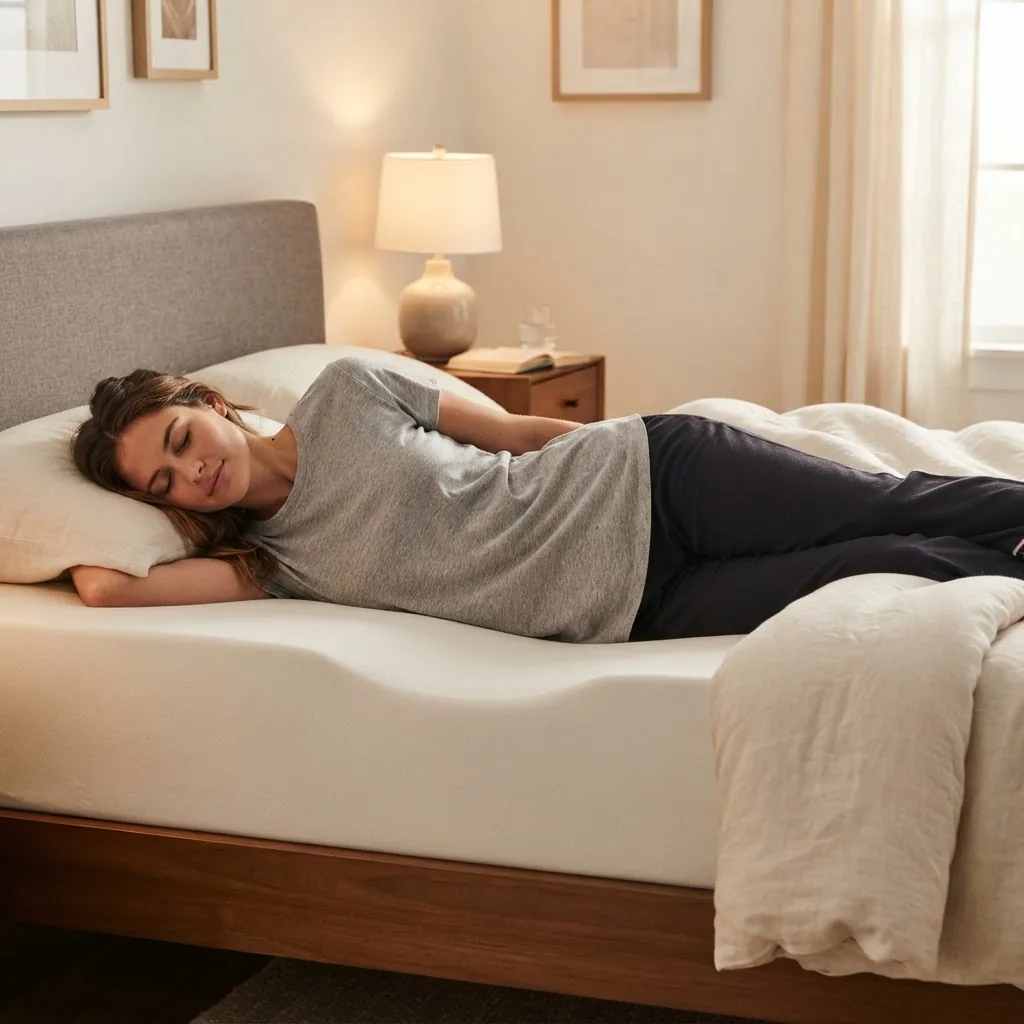
Construction: memory foam mattresses typically have multiple foam layers—base high-density foam for support and one or more viscoelastic layers for contouring. Key material specs:
- Foam density: Measured in pounds per cubic foot (PCF). Higher density (≥5 PCF) gives better durability and deeper contouring; lower density (≤3 PCF) feels quicker to respond but may break down faster.
- Indentation load deflection (ILD): a firmness measure for foam; memory foam often lists both density and ILD.
Performance characteristics:
- Pressure relief: Excellent—memory foam cradles shoulders and hips, aiding side sleepers and those with focal pressure pain.
- Motion isolation: Superior—viscoelastic foam dampens movement, beneficial for light sleepers with active partners.
- Temperature regulation: Can be a downside—traditional memory foam retains heat; newer gel-infused or open-cell foams improve airflow.
Pros and cons:
- Pros:
- Outstanding pressure relief and contouring for side sleepers and those with joint pain.
- Minimal motion transfer—better for couples with different sleep schedules.
- Quiet and stable surface with fewer disturbances.
- Cons:
- Heat retention in older dense foams; upgrades (gel, graphite, open-cell) can help.
- Can feel “stuck” for some combination sleepers when deep contouring slows repositioning.
- Lower-density foams degrade faster—expect variation in longevity.
Example use cases:
- Side sleepers who need pressure relief at shoulders and hips.
- Couples prioritizing motion isolation and minimal partner disturbance.
- People with specific pressure-point pain who benefit from contouring support.
Real-world examples and testing: According to a 2023 Consumer Reports mattress review, high-density memory foam mattresses perform best on durability and pressure relief tests, while lower-density foams score lower on lifespan; independent lab testing often measures foam density, ILD and compression set for warranty evaluations.
Care and durability: memory foam mattresses typically last 7–10 years when made with ≥4–5 PCF base foam; maintain a breathable cover, follow manufacturer recommendations for rotation, and check CertiPUR‑US certification for low VOC and durability standards (CertiPUR‑US).
Tool walkthrough: to assess memory foam firmness at home, press a 10 cm section with steady thumb pressure—observe rebound time and how long an impression holds to approximate viscoelastic response; for objective comparison, note the foam density and ILD values on spec sheets.
Transition: Latex mattresses offer a natural, responsive alternative with distinct durability and temperature behavior.
Latex Mattresses?
Answer: Latex mattresses use natural or synthetic latex rubber to deliver responsive contouring, strong durability and generally better breathability than dense memory foam; choice between natural and synthetic affects eco‑credentials and feel.
Term: Natural latex is harvested from rubber trees and processed into Dunlop or Talalay latex; synthetic latex is petroleum-derived and mimics some latex properties.
How they’re made:
- Dunlop latex: denser, firmer at the base of the block, often used for support layers.
- Talalay latex: lighter and more uniform, typically used for comfort layers with a springier, aerated feel.
- Latex layers may be layered over foam or coil cores in hybrid builds, or form a full-latex mattress.
Benefits:
- Long lifespan—well-made latex mattresses commonly exceed 10 years.
- Responsive support with a buoyant, yet contouring feel—good for combination sleepers and those who dislike the stuck feeling of memory foam.
- Natural latex tends to be breathable and resists dust mites and mildew better than some foams.
- Eco-option: natural latex carries sustainable production and biodegradable properties when certified.
Trade-offs:
- Higher upfront cost for natural latex compared to many foams or innersprings.
- Weight—latex mattresses are heavy and can be difficult to move.
- Allergy considerations: true latex can trigger symptoms in latex-allergic individuals; for others, the dense structure may be hypoallergenic when properly manufactured.
Use cases and health considerations:
- Buyers wanting a durable, responsive surface with eco credentials may prefer natural latex.
- Combination sleepers appreciate the quick response and reduced sinkage compared to memory foam.
- People with allergies should confirm latex suitability—if severe latex allergy exists, synthetic or non-latex alternatives are safer.
Durability and standards: independent testing and manufacturer warranties often reflect latex’s longevity; check for third-party certifications (blended or natural percentage labeling) and consider a 10+ year expected lifespan for high-quality natural latex.
Transition: Hybrids blend coil support with foam or latex comfort layers to balance features—see a direct comparison below.
Hybrid Mattresses?
Answer: Hybrid mattresses combine a coil support core with foam or latex comfort layers to blend responsiveness, contouring and breathability, often delivering balanced comfort suitable for a wide range of sleepers.
Term: Hybrid refers to mattresses that pair a spring core with at least one layer of foam or latex above it, aiming to capture the strengths of both systems.
Below is a concise comparison table of hybrid mattresses against innerspring and memory foam to highlight core differences in construction and performance.
| Feature | Innerspring | Memory Foam | Hybrid |
|---|---|---|---|
| Core support | Metal coil unit (various coil types) | High-density foam base | Coils with foam/latex comfort layers |
| Pressure relief | Moderate (depends on top layers) | High | Balanced—good contour with support |
| Breathability | High | Lower (unless ventilated) | Good—coil airflow plus breathable comfort foams |
| Motion isolation | Variable | Excellent | Good (pocketed coils improve isolation) |
| Typical sleepers who benefit | Back and stomach sleepers preferring bounce | Side sleepers and pain relief seekers | Combination sleepers and couples seeking balance |
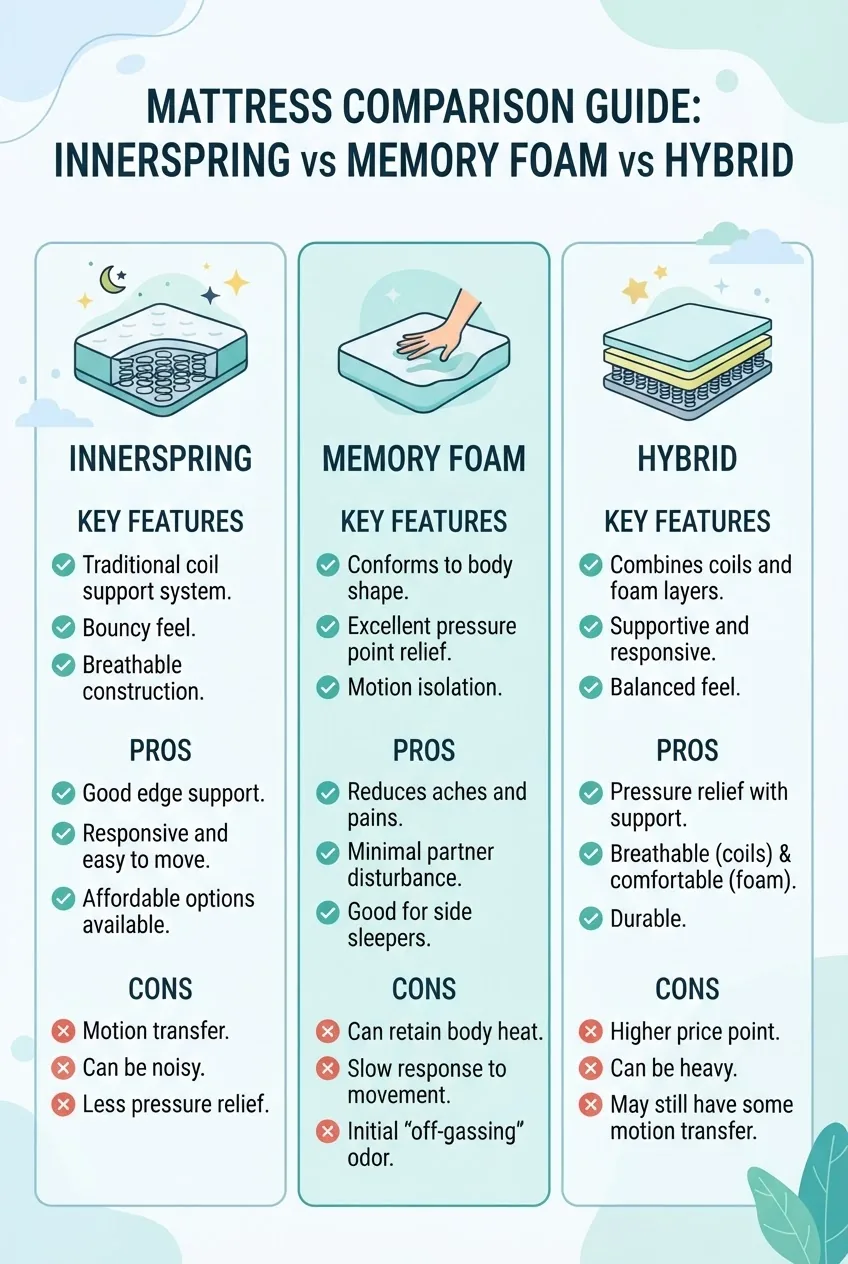
Why choose a hybrid? Hybrids aim to minimize the trade-offs—improved breathability from coils, contouring from foam or latex, and better edge support than all-foam options. Pocketed coil hybrids provide the best motion isolation among coil-based designs.
Durability and expected lifespan: depends on coil quality, foam densities, and manufacturing; well-constructed hybrids typically last 8–12 years when built with high-density base foam and premium pocketed coils, per independent lab testing referenced in a 2024 industry report.
Transition: less common mattress kinds like air mattresses and waterbeds offer adjustable firmness and unique trade-offs—briefly explored next.
Air Mattresses, Waterbeds and Other Alternative Types?
Answer: Alternative mattress types—air mattresses, waterbeds and other uncommon designs—offer adjustable firmness or portability but have distinct maintenance, support and durability trade-offs compared with mainstream mattress kinds.
Air mattresses: Use internal air chambers you inflate to tune firmness; high-end dual-chamber systems allow partner customization. Pros include adjustable firmness and longevity of air chambers when maintained; cons include dependence on pumps, more complex service and potential leaks.
Waterbeds: Use water-filled chambers for a buoyant feel; modern models may use baffled or wave-reducing designs. Pros include even pressure distribution and unique motion characteristics; cons include heavy weight, temperature control needs (heaters), and potential for leaks.
Other uncommon mattresses:
- Futon cores (folding, variable stiffness).
- Air-foam hybrids (thin air bladders atop foam).
- Inflatable camping mattresses (portable, low-cost).
Pros and cons (summary):
- Pros: Adjustable firmness (air), unique pressure distribution (water), portability (inflatable camping).
- Cons: Complex maintenance (waterbeds, high-end air systems), temperature control requirements, potential leaks or pump failures.
Use cases:
- Air systems: couples needing different firmness sides or users who change firmness seasonally.
- Waterbeds: niche users who prefer a buoyant, floating sensation and can accommodate weight/temperature needs.
- Portable inflatables: travel, camping or short-term guest needs.
Transition: Knowing types is only part of the decision—selecting the right mattress kind requires evaluating key factors related to your body, sleep habits and environment.
What Key Factors Should I Consider When Choosing Mattress Types?
Answer: Prioritize sleep position, body weight, temperature regulation, support vs pressure relief, durability and allergy considerations to match mattress type to personal needs and lifespan expectations.
Below are numbered considerations with clear explanations and actionable signals to help you choose the right mattress kind; use these factors to transition from understanding types to comparing models.
- Sleep position: Side sleepers need pressure relief at shoulders and hips, favoring memory foam, latex or plush hybrids; back and stomach sleepers typically need firmer support, often found in innerspring or firmer hybrids.
- Body weight: Lighter sleepers (<130 lb) may prefer lower firmness to allow hug; average (130–230 lb) seek balanced support; heavier sleepers (>230 lb) benefit from sturdier support cores—look for thicker profiles, higher coil counts, stronger gauge or high-density foams.
- Temperature regulation: If you sleep hot, favor innerspring, latex, or hybrids with ventilated foams; memory foam can trap heat unless designed with cooling additives or open-cell structure.
- Support vs pressure relief: Determine whether you need spinal alignment (support) or localized cushioning (pressure relief). Use a firmness testing method—press and note how your hips and shoulders align when lying on your side or back.
- Motion isolation for couples: If partner disturbance matters, prioritize memory foam or pocketed-coil hybrids; traditional interconnected coils transfer more motion.
- Durability and expected lifespan: High-density foam, natural latex and quality pocketed coil systems last longer; set realistic horizons—7–12 years depending on build quality and usage. According to a 2024 industry report, material density and coil construction are the leading predictors of longevity.
- Allergies and materials: Natural latex resists dust mites; hypoallergenic covers and breathable cores reduce allergen buildup. For chemical emissions, look for third-party certifications—see CertiPUR‑US for foam safety standards.
- Thickness/profile: Mattress thickness influences durability and support—thicker profiles (12–14″) often allow more layers for targeted support; thin mattresses (8–10″) may be fine for lighter sleepers or platform beds.
- Edge support needs: If you sit on the bed frequently or use the whole surface, innerspring and hybrids with reinforced rails provide firmer edges than many all-foam beds.
- Budget vs value: Allocate budget where performance matters most for your needs—spend on higher-density foams or better coils if you need durability and support; lower-cost options may suffice for guest rooms or short-term use.
Practical test checklist (quick at-home checks):
- Lie on each mattress for at least 10–15 minutes in your typical sleep position.
- Check hip and spine alignment—neutral spine indicates adequate support.
- Note immediate pressure points at shoulders and hips for side sleeping.
- Ask about foam density, coil type and gauge—these specs predict feel and lifespan.
For step-by-step buying decisions and trial considerations, consult the mattress buying guide for how to choose the best mattress.
Remember support and comfort considerations extend beyond mattresses to seating; see our best sofa for back problems guide for parallel advice on back support in couches.
Transition: Firmness often confuses buyers—next we explain how firmness scales relate to mattress types and sleepers.
How Does Mattress Firmness Relate to Mattress Types?
Answer: Firmness is a separate axis from mattress type—each type can be made soft, medium or firm; the firmness scale (1–10) helps match feel to sleep position and pressure needs.
Term: Firmness scale typically rates 1 (very soft) to 10 (very firm); most consumers find 5–7 medium-firm suitable for a range of sleepers.
How types map to firmness tendencies:
- Innerspring: Often in the medium-firm range with strong edge support; pillowtops create plusher options.
- Memory foam: Available across firmnesses—low ILD and high contouring create softer feel even at higher density.
- Latex: Tends to feel firmer and more responsive at the same ILD compared to memory foam due to faster rebound.
- Hybrid: Can be tuned widely by coil count/gauge and foam layer thickness to achieve specific firmness and support targets.
Firmness guidance by sleeper type:
- Side sleepers: generally 3–6 on the firmness scale to cushion shoulders and hips.
- Back sleepers: generally 4–7 to maintain lumbar support and avoid sagging.
- Stomach sleepers: generally 6–8 to prevent midsection sinkage and maintain spinal alignment.
- Combination sleepers: 5–7 to balance ease of movement and pressure relief.
Short infographic suggestion: create a compact visual mapping firmness scale (1–10) to recommended sleeper types, with icons and quick callouts for each mattress type to use in product pages or the media plan.
Transition: Several common myths about mattress types can mislead buyers—next we address those directly.
What Are Common Misconceptions About Mattress Types?
Answer: Common mattress myths include “firmer is always better for back pain,” “memory foam always sleeps hot,” and “natural latex is always hypoallergenic”; these statements are oversimplifications—real outcomes depend on construction, density and individual factors.
Debunked myths (Q&A style):
- Myth: Firmer mattresses always relieve back pain. Fact: Support and spinal alignment matter more than raw firmness—medium-firm beds often balance contour and support better for many with back pain, per National Sleep Foundation guidance (National Sleep Foundation).
- Myth: Memory foam always sleeps hot. Fact: Memory foam historically retained heat, but open-cell, gel-infused and ventilated foams address this—type and thickness determine temperature behavior.
- Myth: All-natural materials are universally hypoallergenic. Fact: Natural latex can trigger latex allergies; “natural” claims should be supported by certifications and ingredient transparency.
- Myth: Higher price always means better fit. Fact: Price correlates with materials and craftsmanship but matching type to sleep needs gives better real-world satisfaction than price alone.
Short case study: a 45-year-old side sleeper who switched from a too-firm innerspring to a medium-memory-foam hybrid reported reduced shoulder pain within three weeks—this reflects matching pressure relief and support rather than simply choosing the most expensive model.
Transition: Proper maintenance extends the life of any mattress type—follow these type-specific care steps next.
How Do I Maintain My Mattress by Type?
Answer: Maintenance steps vary by type: rotate and air innersprings, avoid moisture for memory foam, spot-clean and use breathable covers for latex, check air pumps for air systems, and follow manufacturer guidance for waterbeds.
How-to maintenance steps (by mattress type):
- Innerspring: Rotate every 3–6 months if manufacturer allows; vacuum top surface; use a mattress protector; inspect for sagging and coil noise. Avoid folding or bending coils.
- Memory foam: Use a breathable, washable cover; spot-clean spills with mild detergent; avoid soaking; air out occasionally to reduce odors from off-gassing. Do not flip unless specified—rotate instead.
- Latex: Rotate or flip per manufacturer (many latex beds can be flipped); vacuum; avoid prolonged exposure to humidity; use a supportive base to prevent compression.
- Hybrid: Follow both foam and coil guidance—rotate, use a strong platform or slatted base with proper spacing, and protect with a mattress cover.
- Air systems: Monitor pump function, seals and valves; follow inflation guidelines to avoid overpressure; store pump indoors; repair punctures promptly.
- Waterbeds: Maintain heater settings, add conditioner as recommended to control bacteria and prevent liner hardening, and check for delamination or leaks regularly.
Increasing mattress life:
- Use a supportive bed base suited to mattress type (solid platform for foam, slats within recommended spacing for hybrids and innersprings).
- Use a mattress protector to guard against stains and moisture.
- Follow manufacturer warranty terms—most warranties require proper support and care to remain valid.
Limitations: Warranties do not guarantee indefinite lifespan—expect material compression (softening) and coil fatigue over time; according to a 2024 industry white paper, compression set and foam density loss are primary drivers of perceived end-of-life.
Transition: Final summary and clear next steps will help you convert mattress type understanding into action.
Summary and Next Steps for Selecting the Right Mattress Kind?
Answer: Identify your primary needs—sleep position, body weight, temperature, motion isolation—and match them to a mattress kind (innerspring, memory foam, latex, hybrid or alternatives); use type knowledge to evaluate models, then consult buying guides and brand resources for the final purchase.
Actionable next steps:
- List your non-negotiables (temperature, pressure relief, partner disturbances).
- Choose 1–2 mattress kinds that fit (for example, memory foam or hybrid for side-sleepers needing pressure relief).
- Compare models focusing on foam density, coil type/gauge, and firmness scale ratings.
- Check for third-party certifications (CertiPUR‑US for foam) and independent test summaries (Consumer Reports) before deciding.
Further reading and complementary furniture planning:
couch dimensions guide for choosing the perfect sofa size — consider mattress selection as part of room planning and pair your mattress choice with the right sofa sizing to optimize living and bedroom layouts.
Also explore the best couches buying guide for comfortable and affordable options to align bedroom comfort with living-room seating choices.
If you’re interested in style pairings, see the different couch styles guide to choose your ideal sofa type to match aesthetic and ergonomic priorities.
After narrowing types, consult the mattress brands guide to find the most comfortable beds for model-level research and verified performance data.
For living-room decor and seating comfort that complements bedroom choices, check our sofa ideas guide for stylish and comfortable living room seating.
Authoritative resources and standards cited:
- Consumer Reports — for mattress performance and consumer-satisfaction data (see 2023 mattress reviews).
- National Sleep Foundation — for sleep health guidance related to mattress support and comfort.
- CertiPUR‑US — for foam emission and durability standards.
Final CTA: Use this types-first framework to reduce options quickly—identify the right mattress kind for your needs and then move to model comparisons using firm specs (foam density, coil gauge) and independent reviews before purchasing.