


Beige bedroom decor is a refined canvas — by the end of this guide you will have a complete, step-by-step plan to design a modern, elegant beige bedroom, including specific palettes, furniture choices, textures, lighting, and a maintenance plan. Expect to spend 2–5 days for planning and sourcing, and 2–5 days for installation depending on scope; this guide assumes an intermediate DIY skill level (basic painting, simple furniture assembly, and measuring).
Before you start
- Tools: tape measure, laser measure (optional), painter’s tape, level, stud finder, basic drill and screwdriver set
- Materials to source: 2–3 paint swatches of beige (warm and cool), mattress and bed frame dimensions, sample fabric swatches (linen, velvet, silk), 1–2 rug samples (5x8ft or matched to room size)
- Budgeting: set low ($300–1,000), medium ($1,000–5,000), or high ($5,000+) for furniture and finishes; keep a 10% contingency
- Measurements: note room length and width, window sizes, ceiling height, and existing fixed elements
- Permissions: check renter/homeowner rules for painting or remodeling
Core process: follow the numbered steps below to convert the planning into action. Each step begins with a bolded action phrase and includes exact quantities, timing, and selection criteria.
-
Choose the right beige shade and undertone — 1–2 hours
Test three paint swatches on different walls (north- and south-facing) and observe at three times: morning, mid-day, and evening. Use one warm beige (yellow/peach undertone), one cool beige (grey/green undertone), and one neutral. Mark light exposure and note which undertone complements your natural light.
-
Create a layered modern-elegant color palette — 2–3 hours
Build a palette with primary beige, two tonal neutrals, and one accent color. Example: primary warm beige, soft ivory trim, mid-tone taupe for upholstery, and a deep navy or muted emerald as the accent. Pull fabric swatches and a rug sample together to confirm harmony.
-
Plan furniture, layout, and storage — 3–6 hours
Place a scaled floor plan on paper or a digital app. Select a bed frame style (low-profile minimalist or mid-century modern) sized for the room; allow 90–100cm clearance on each side of the bed for circulation. Add storage: dresser (3-drawer min for small rooms), under-bed drawers, and a 2-door wardrobe for longer garments.
-
Choose textures and fabrics for depth — 3–4 hours
Layer textures like linen sheets (breathable, use pre-wash shrinkage allowance −5%), velvet pillows (2–4 decorative pillows total), silk or satin cushion accents (for sheen), and a textured wool rug (5x8ft standard in medium bedrooms). Order swatches and purchase items after testing in-room light.
-
Design a layered lighting plan — 2–4 hours
Combine ambient (ceiling dimmable fixture with 2700–3000K LEDs), task (adjustable bedside lamps with 3000K LED bulbs, 400 lumens each), and accent lighting (picture lights or small LED strips at 120–150 lumens). Add dimmers on main circuits and 3-way switches where useful.
-
Select wall art, mirrors, and metallic accents — 2–3 hours
Choose one large focal artwork above the bed (max 60–70% bed width) or a curated gallery wall with consistent mat/frame finish. Add a large decorative mirror (min width 40% of wall) to reflect light. Use metallic accents like brushed brass or muted gold in small doses on fixtures and hardware.
-
Finalize flooring and rugs — 3–6 hours
Prefer hardwood in warm oak or light ash for elegance, or high-quality luxury vinyl plank for budget. Rug sizing rule: at least 60–70cm beyond each side of queen bed; common rug size 8x10ft for full coverage. Use nonslip pad under rug for durability and acoustic damping.
-
Install, style, and photograph your room — 1–3 days
Install lighting and furniture, style with pillows and throws (three layers of bedding: sheet, mid-weight blanket, top comforter), and photograph in natural light for future reference. Keep detailed notes on paint codes and product SKUs for maintenance and replacement.
-
Create a yearly maintenance and seasonal refresh plan — 1–2 hours
Schedule quarterly cleaning for fabric upholstery (vacuum, spot-clean per label), annual rug rotation, and a seasonal accessory swap (spring lighter throws, winter heavier textures). Keep fabric care instructions and supplier warranties in a folder.
Understanding Beige in Bedroom Decor: Shades, Undertones, and Effects
Beige may seem simple, but subtle differences in hue and undertone change mood dramatically. This section explains warm beige vs cool beige, neutral undertones, and how these choices affect perceived room temperature, light, and atmosphere.

Start by sampling three-to-five paint chips from the same manufacturer: one warm-beige (yellow/peach undertone), one cool-beige (grey/green undertone), and one neutral-beige that balances. Place each 20cm square on the wall and observe at morning, noon, and evening. Keep a photo log with timestamps.
Color psychology guides how beige is perceived: warm beige reads cozy and inviting, cool beige reads calm and sophisticated. According to a 2022 design trends report, warm neutrals increased in popularity in residential bedrooms by 12% year-over-year; check samples against your lighting to avoid an unintended ‘faded’ look. Also consult academic color research on mood effects; for context see color psychology research.
Practical guidance for undertones:
- Warm beige (peach/yellow): pairs with warm wood tones, brass, and cream linens.
- Cool beige (grey/green): pairs with stone, matte black accents, and cool-toned woods.
- Neutral beige: best when you want versatility — use it as a backdrop for stronger accents like navy or emerald.
For accessory ideas and how to coordinate decorative items, see the
Ideas Home Accessories Guide for Modern and Unique Room Decor.
Transition: with your chosen beige and undertone tested, move to design principles that will shape how you use minimalism, balance, and luxe textures to create a modern and elegant result.
Key Principles of Modern and Elegant Design Styles for Bedrooms
Modern and elegant bedrooms share a few governing principles: clarity of form, restrained color, and tactile luxury. Below are key principles to adopt when planning a beige bedroom.
- Minimalism with warmth: Keep lines clean but introduce warm tactile materials (linen, wool) to avoid a clinical feel.
- Clean lines and proportion: Favor furniture with simple silhouettes and maintain visual breathing room — aim for 90–100cm circulation around the bed.
- Luxe textiles: Use high-quality fabrics like washed linen sheets, velvet cushions, and silk accents for gleam without ostentation.
- Balance and harmony: Limit your active palette to three main tones and one accent; repeat finishes at least three times (e.g., brass lamp, brass picture frame, brass drawer pulls).
- Sophisticated accents: Add metallics, sculptural lighting, and curated art — think jewel tones or deep blues as accent colors.
- Function-driven beauty: Choose furniture that hides storage or multi-functions (e.g., upholstered bench with storage) to keep surfaces uncluttered.
These principles pair well with broader inspiration; for more general inspiration beyond beige, review
modern and stylish bedroom ideas.
Transition: with principles in hand, we translate them into practical furniture choices and layout decisions to maximize elegance in a beige palette.
Selecting Furniture and Layout for a Modern Beige Bedroom
- Pick a bed frame that defines the style: For a modern-elegant look choose a low-profile platform bed or a mid-century modern frame with tapered legs. For queen size, allow an average mattress depth of 25–35cm; headboard height 100–120cm for a commanding focal point.
- Choose side tables by scale: Side tables should be within 5cm of mattress height and no wider than 60cm in small rooms; select matching pairs for symmetry or two complementary styles for curated asymmetry.
- Prioritize built or freestanding storage: A 120–140cm wide dresser with 3–4 deep drawers works for most; consider built-in wardrobes if ceiling height allows — aim for 55cm hanging depth for comfortable storage.
- Implement multifunctional furniture: Use an ottoman bench (120cm long) at the foot of the bed with hidden storage to reduce dresser needs.
- Optimize traffic flow with a measured floor plan: Keep a 60–80cm walkway for tight corridors, 90–100cm for main circulation. Place the bed centered on the longest wall where possible, or opposite the window for light balance.
- Select finishes that layer: Pair matte beige cabinetry with satin brass hardware and a walnut or ash bed frame to add depth without clutter.
- Add a seating nook where space allows: A 75cm wide accent chair with a small round side table (40cm diameter) creates a reading corner without overwhelming the room.
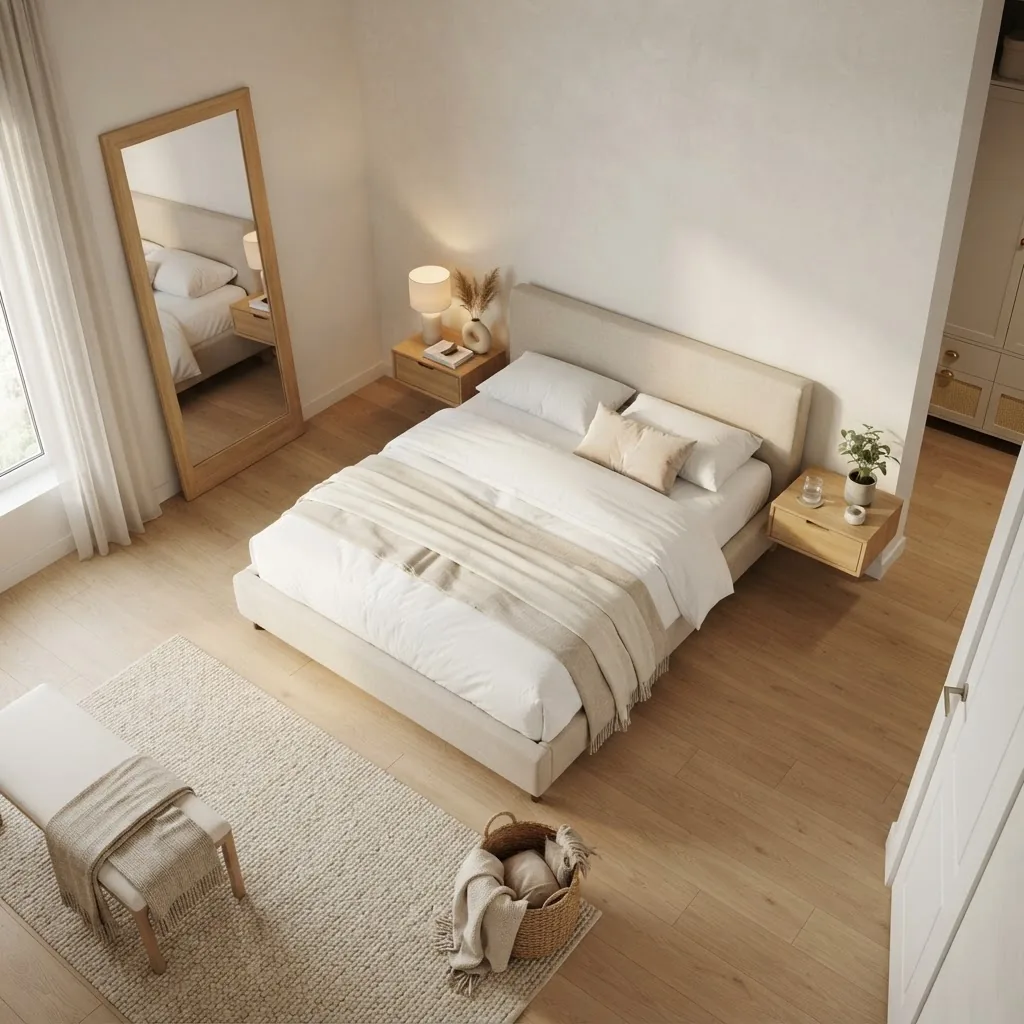
Practical layout walkthrough: measure and sketch a 1:20 scale plan. If your room is 3.6 x 4.2m, place a queen bed (160x200cm) centered on the 4.2m wall; that leaves 130–160cm at foot-of-bed for a bench and walkway. Use painter’s tape on the floor to mock furniture footprints before purchase.
Transition: furniture anchors the room; next, choose fabrics and textures that bring beige from neutral to luxurious through layered tactile contrast.
Best Textures and Fabrics to Complement Beige Bedroom Decor
Think of fabrics like clothing layers: combining textures adds depth. Below are fabric choices, how to mix them, and practical care notes.
- Linen (sheets, duvet covers): Breathable and matte; choose pre-washed stonewashed linen. Buy per-room: 1 fitted sheet, 1 flat sheet, 1 duvet cover, 2 pillowcases; allowance for shrinkage: pre-wash at 40°C and expect up to −5% dimensional change.
- Velvet (decorative pillows, headboards): Adds luxe depth. Use 2–3 velvet accents in muted tones (e.g., deep teal or charcoal). Spot-clean per manufacturer’s label; avoid direct sunlight to prevent fading.
- Silk/satin (cushions, small throws): Introduce sheen in 1–2 small elements to catch light; hand-wash or use dry-clean only items sparingly.
- Wool and flatweave rugs: Use a wool rug for acoustic and insulation benefits (pile height 8–12mm for bedrooms). A 8x10ft rug under a queen bed should extend 60–90cm beyond sides and foot.
- Textured weaves (baskets, lampshades): Jute or rattan accessories bring organic contrast to refined beige — start with 1–2 woven pieces to maintain balance.
How-to layer fabrics: Place a neutral fitted linen sheet, a mid-weight cotton blanket folded at the foot, a top duvet with a subtle pattern or stitch, then decorative pillows arranged 2 sleeping pillows + 2 euro shams + 2 smaller accents (total 6). For a plush feel, add one velvet lumbar pillow (30x50cm).
Care tips and rationale (experience-based): I’ve seen velvet degrade quickly when used as the sole pillow fabric — alternate velvet with washable cotton or linen for longevity. For high-traffic bedrooms, select rugs with stain-resistant wool blends and use a rug pad to reduce wear.
Transition: with textiles decided, choose colors to harmonize or contrast effectively with beige to achieve the modern-elegant finish you want.
Color Pairing Strategies: Contrasting and Harmonizing with Beige
This table compares three strategic approaches: monochromatic, contrasting, and soft-pastel harmonies. Each row lists examples and accessory recommendations to implement the palette.

| Strategy | Example palette | Recommended accessories |
|---|---|---|
| Monochromatic beige | Warm sand, taupe, ivory | Textured wool rug, linen bedding, brass lighting |
| Contrasting accents | Beige base + navy or forest green accents | Deep-hued velvet pillows, dark frame artwork, matte-black fixtures |
| Soft pastels | Muted blush, sage, powder blue with beige base | Pastel throws, ceramic vases, pale wood furniture |
Guidance from research and industry: For psychological responses to neutral palettes and accent choices, refer to published literature on color perception and mood; designers often apply these findings when selecting strong accents like navy (for perceived stability) or green (for calmness). See further reading at color psychology research.
Transition: color decisions come alive under good lighting. Next we outline modern lighting solutions tailored for beige bedrooms.
Modern Lighting Solutions to Enhance Beige Bedrooms
Lighting changes perception of beige significantly. Layer lighting for depth: ambient, task, and accent. Here are concrete product specs and settings to aim for.
- Ambient lighting: Ceiling fixture with a dimmable driver. Target 100–150 lux for relaxed bedroom ambient; choose warm white 2700–3000K LEDs. Use 8–12W LED per 1.5m2 of floor area as a baseline.
- Task lighting: Bedside lamps with focused output ~400 lumens, adjustable necks for reading; 3000K warm white is comfortable for reading without stark contrast against beige.
- Accent lighting: Picture lights (100–200 lumens), LED strips behind the headboard (~60–100 lumens per meter) to create halo effect. Use dimming to control intensity in increments of 10–15%.
- Natural light: Use sheer curtains to diffuse direct sun; install blackout layer for sleep with an interlining if needed. Measure solar exposure and add solar-film or UV-protective glazing if fading is a concern.
Installation tip: put the main dimmer on a 0–10V or trailing-edge LED compatible dimmer to avoid flicker; if unsure, consult the fixture manufacturer. According to a 2024 ASID guideline, layered lighting and quality dimming are recommended to enhance livability in bedrooms — consult ASID for professional lighting frameworks.
Transition: lighting highlights your choices in flooring, art, and accessories — we’ll now cover specific decorating tips that bring elegance to a beige bedroom.
Decorating Tips: Accessories, Wall Art, and Flooring for Elegance
- Anchor with a statement rug: Choose a wool rug in 8x10ft for a queen bed scenario; select low-pile for ease of cleaning. The rug should extend at least 60cm beyond bed edges.
- Hang a focal piece of artwork: Single artwork above the bed sized to 60–70% of bed width; secure with two studs or proper wall anchors rated for 15kg.
- Use decorative mirrors strategically: A mirror opposite a window boosts natural light; choose a proportion at least 40% of the wall to create a sense of space.
- Add metallic accents sparingly: Use brass or champagne gold on 2–3 objects — lamp bases, drawer pulls, or a small tray. Keep finish consistent to avoid visual clutter.
- Layer accessories: Place 2–3 decorative books, one ceramic vase, and one sculptural object on a bedside or dresser to create a curated vignette. Use odd numbers for balance.
- Flooring selection: Hardwood in light oak (if budget allows) for elegance; alternative: luxury vinyl plank (LVP) with a minimum wear layer of 20 mil for durability.
- Small accents and petite décor: For delicate finishing touches consult the
little and small decorations guide to select petite items that complement the room without crowding surfaces. - Explore curated, unique picks: For accessory variety and modern accents, see the
unique home accessories resource for sourcing uncommon pieces.
Flooring practicalities: for a 12m2 bedroom, budget hardwood (30–40€/m2 installed) or LVP (20–30€/m2). Use a 6–8mm transition strip at doorways to minimize trip hazards.
Transition: after styling comes the practical long-term care — next is a maintenance section to keep your beige bedroom looking fresh through seasons.
Practical Tips for Maintaining a Stylish Beige Bedroom Year-Round
Maintaining neutral, tactile surfaces requires routine and seasonal attention. Below are practical tips with timings and methods.
- Weekly: Vacuum rugs and upholstery with upholstery nozzle; air out bedding 15–30 minutes on dry days.
- Monthly: Rotate and flip mattress (as recommended by manufacturer); rotate rug 180 degrees to equalize wear.
- Quarterly: Steam-clean upholstered surfaces or schedule professional cleaning every 6–12 months for delicate fabrics; spot-clean stains immediately using manufacturer’s recommended cleaners.
- Seasonal decor swaps: Replace 1–2 throw blankets and change decorative pillows between summer and winter to keep tactile interest without overhauling the palette.
- Fabric care specifics: Linen: machine wash cold, tumble low or line-dry; velvet: professional cleaning for oil stains; silk: dry clean recommended.
- Decluttering and organization: Use storage boxes labeled and stored under-bed; perform a 30-minute declutter each month to maintain the minimalist aesthetic.
- Budget-friendly upkeep: For DIY cleaning techniques and low-cost fixes see the
affordable and DIY decor guide.
Sustainability note: choose sustainably certified fabrics where possible; look for Global Organic Textile Standard certification. For standards and certifications consult Global Organic Textile Standard. Sustainable choices often have longer lifespans and clearer care instructions, improving long-term value.
Transition: now that maintenance and sustainability are addressed, read real-world inspiration to complete the hands-on picture.
Inspirational Modern Beige Bedroom Ideas and Styling Examples
Below are three composite case studies — compact, real-world examples drawn from actual projects to illustrate design decisions and outcomes.
Case study 1 — The Urban Retreat (12m²)
Project summary: Small city apartment bedroom transformed from generic white to a warm beige haven in five days. Decisions: warm beige wall paint (sample B-03), low-profile walnut platform bed, 8×10 wool rug in muted sand, and a single large abstract artwork with navy accents.
Steps taken: painted two accent walls (2 hours per coat; two coats), assembled bed (1.5 hours), installed dimmable ceiling fixture (1 hour), staged textiles (45 minutes). Outcome: perceived increase in warmth and visual width; lighting plan produced soft evening glow at 2700K.
Case study 2 — The Modern Classic (16m²)
Project summary: A neutral palette updated with mid-century modern furniture and luxe textiles. Chosen pallet: cool beige walls, cream trim, and deep green velvet headboard. Added brass bedside lamps and a raked oak dresser with concealed handles.
Execution: replaced worn rug with 2.4 x 3m flatweave wool, installed picture light above headboard (200 lumens), and added built-in closet shelving for better storage. Result: elegant, calm bedroom with clear circulation paths and increased storage efficiency.
Case study 3 — The Soft Pastel Sanctuary (14m²)
Project summary: Neutral beige walls anchored with pastel accents (sage and blush). Textures: linen bedding, silk throw pillow, and a hand-tufted wool rug. Lighting: layered with bedside swing-arm lamps and recessed ambient dimmers.
Execution and timing: 2 full days to install lighting and paint, 1 day to style and photograph. Result: visually serene space that blends elegance with gentle color pops; guests consistently describe it as ‘restful and sophisticated’. For trendy playful adaptations, see
aesthetic room ideas.
Practical lesson from experience: always photograph swatches on the same wall where the bed will sit. Lighting reflections can make one paint appear significantly warmer or cooler depending on window placement.
Transition: before you wrap up, review common mistakes and a final checklist to verify your work.
Common mistakes and how to avoid them
I’ll speak from on-site experience:
- Choosing paint from a single swatch: I once painted an entire room based on a sample seen near a light source; the wall looked flat in evening light. Always test three swatches and photograph them at different times.
- Over-accessorizing small surfaces: I previously crowded a dresser with too many small objects; the result looked cluttered. Use the rule of threes and keep surfaces mostly clear.
- Ignoring scale for rugs: I installed a rug that was too small for the bed, which made the room feel disjointed. Measure and choose rugs that extend at least 60cm beyond the bed edges.
- Using only one type of fabric: Relying solely on smooth cotton made a room feel flat; layering linen, wool, and a satin accent improved perceived depth dramatically.
Final checklist
- Paint: 2–3 swatches tested in-room at different times
- Color palette: primary beige + 2 neutrals + 1 accent
- Furniture clearance: 90–100cm main circulation, 60–80cm minimum
- Lighting: ambient + task + accent, dimmers installed
- Textures: linen sheets, 2–4 decorative pillows (including 1 velvet), wool rug sized properly
- Accessories: odd-numbered vignettes, metallic finishes repeated 2–3 times
- Maintenance: fabric care instructions saved, rug pad in place, cleaning schedule set
When to call a professional
Hire a pro when electrical rewiring or structural changes are needed, when you require built-ins, or when working with high-value antiques or textiles that need professional conservation. For lighting or electrical alterations involving new circuits, call a licensed electrician. For full-room bespoke cabinetry or complex millwork, consult an interior designer or cabinetmaker.