


By the end of this guide you’ll know exactly what pieces to buy, which materials and styles suit your household, and how to size, budget and maintain your setup — this process typically takes 4–10 hours of planning and shopping and assumes a basic comfort with measuring, online research and decision-making.
Before you start
- Tools: tape measure (25 ft), laser distance measure (optional), notebook or phone for photos, tape for marking floor clearances.
- Materials: floorplan or measured sketch, photos of the room and existing décor, sample fabric swatches if available.
- Accounts: retailer login for saved items, a spreadsheet or notes app to track dimensions, prices and warranties.
- Time budget: block two sessions — one for assessment and measuring (1–2 hours), one for comparing options and purchasing (3–8 hours depending on custom orders).
Transition: Start by understanding purpose and users in the room, then work through furniture types, materials, size and comfort, finishing with budget, buying and maintenance.
-
Understanding Your Living Room Needs Before Choosing Furniture
Living room furniture selection starts with clarity about use: is the room for TV-centric entertainment, formal receiving, multi-use homework and dining, or flexible lounging? Define primary and secondary room function, family size and lifestyle to guide choices.
- Clarify room function: List 1 primary function (e.g., TV/streaming) and up to 2 secondary functions (e.g., workspace, dining). Prioritize seating and surfaces accordingly.
- Count users and patterns: Write down household headcount and typical simultaneous users (e.g., 4 people watching TV, 1 working). For heavy use by kids or pets choose durable fabrics and rounded corners.
- Map traffic flow: Photograph the room and mark arrival points, door swings and high-traffic walkways; keep 30–36 inches clear for major paths in family rooms, 24 inches for secondary paths.
- Inventory existing elements: Note fixed features (TV position, fireplace, windows) and important décor pieces to match scale and style later on.
- Set functional priorities: Rank comfort, durability, and style 1–3 so trade-offs are clear (e.g., comfort=1, budget=2, modern look=3).
Mini case study: I advised a family of five who needed a TV-first family room with a workspace corner. They prioritized durable seating and storage over a statement coffee table; choosing a stain-resistant performance fabric and a media console with hidden storage met all functional goals while keeping costs in check.
Transition: With needs clear, choose the specific furniture types that will meet those functions.
-
Different Types of Living Room Furniture Explained
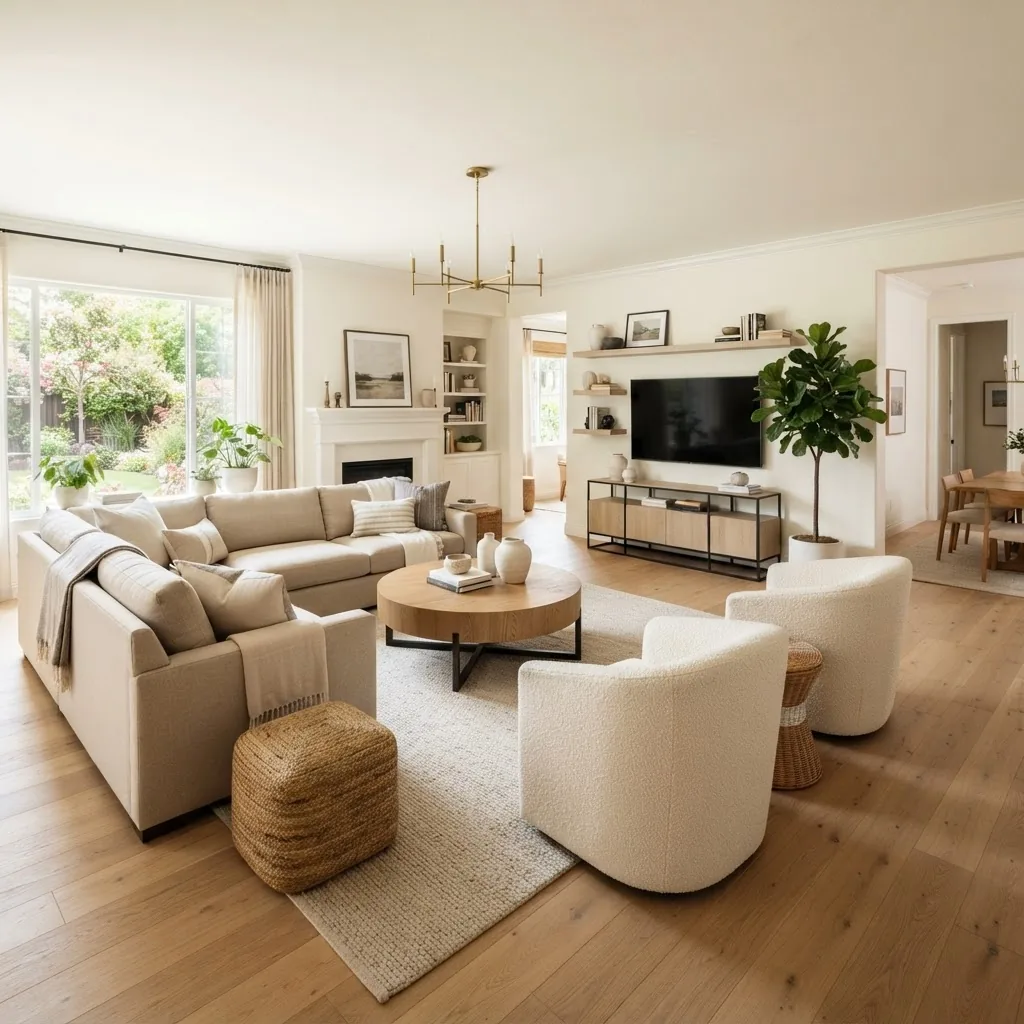
Below is a numbered rundown of essential living room furniture, each with a concise description and realistic pros and cons to help you choose.
-
Sofa (including loveseats and sectionals) — Description: Primary seating; options include standard sofas, loveseats (60–72″ wide), and sectionals (modular pieces).
Pros: Anchors the room, offers large seating capacity.
Cons: Can dominate scale; sectionals may limit layout flexibility.Recommendation: For families of 3–5 choose sofas 84–96″ or modular sectionals to allow reconfiguration.
-
Armchairs and accent chairs — Description: Single-seat chairs that add flexibility and style.
Pros: Easy to move, define conversation clusters.
Cons: Can require larger visual balance if oversized. -
Coffee tables and side tables — Description: Central surface for drinks, remotes and décor.
Pros: Provide usable surface and anchor center; low visual weight vs storage units.
Cons: Need clearance—leave 12–18″ between table and seating for comfortable reach. -
Media consoles and TV units — Description: Holds the TV, AV equipment and cables; sizes typically 48–80″ wide.
Pros: Central organization, integrates cable management.
Cons: TV placement can force seating orientation.
living room furniture around focal points -
Storage units and shelving — Description: Bookcases, built-ins, consoles for concealed or open storage.
Pros: Keeps clutter out of sight, supports media and decor.
Cons: Overuse can make room feel heavy; balance with open shelving.
key furniture pieces -
Ottomans and poufs — Description: Versatile for extra seating or as a coffee-table alternative.
Pros: Light, movable, can include storage.
Cons: Soft surfaces may lack table stability. -
Console tables and entry benches — Description: Place behind a sofa, along a wall, or in an entry area for drop-zone function.
Pros: Add function without bulk.
Cons: Need depth clearance; typically 12–20″ deep. -
TV stands vs mounted TV solutions — Description: Stand-based units offer storage; wall-mounted TVs save floor space but need media boxes or conduit for cables.
Pros/Cons depend on AV needs and wall structure. -
Room rugs — Description: While not furniture, rugs anchor furniture arrangements: full-coverage (all legs on), partial (front legs on) or floating (coffee table only).
Pros: Defines zones, adds acoustics and comfort.
Cons: Wrong size breaks visual cohesion—use rug sizes 5×8, 8×10, 9×12 depending on room size. - Accent cabinets and curio — Description: Display and storage for decorative items; choose smaller footprints in compact rooms.
Transition: After you select which pieces you need, match styles and materials to function and aesthetics.
See key furniture pieces for more on individual items.
-
Sofa (including loveseats and sectionals) — Description: Primary seating; options include standard sofas, loveseats (60–72″ wide), and sectionals (modular pieces).
-
How to Choose the Right Style and Material for Living Room Furniture
Choosing style and material is about balancing durability, comfort and visual cohesion. Below are side-by-side comparisons followed by practitioner guidance.

Style / Material Best for Pros Cons Modern (clean lines, low profiles) Urban, minimalist homes Streamlined appearance, often modular Can feel cold if not layered with texture Traditional (ornament, turned legs) Historic or formal homes Timeless, detailed craftsmanship May feel heavy in small rooms Transitional (blend of traditional and modern) Versatile, suits mixed décor Adaptable, appeals broadly Less distinct personality for those wanting a strong aesthetic Contemporary (current trends) Trend-forward interiors Fresh, often lightweight May date more quickly Material comparisons: Below are key material categories and what to expect.
Material Durability Care Typical Cost Solid hardwood (oak, maple, walnut) Very high — uses Janka hardness scale (oak ~1290) Wipe with damp cloth; occasional oiling Mid–high Metal frames (steel, aluminum) High; resistant to warping Wipe; touch-up paint for scratches Mid Fabric upholstery (linen, cotton blends, performance fabrics) Varies: performance fabrics highest Professional cleaning recommended for natural fibers; spot clean for synthetics Low–mid Leather (aniline, semi-aniline, protected) High; ages well if maintained Condition with leather-specific products; avoid sun exposure Mid–high Notes on trade-offs: choose a higher-grade hardwood for longevity in high-use pieces, but balance that with comfortable upholstery choices. For busy households, select performance fabrics with stain resistance (look for abrasion ratings > 25,000 double rubs for heavy use).
Definitions: Transitional style blends classical proportions with contemporary lines to create a balanced, flexible aesthetic; BIFMA stands for Business and Institutional Furniture Manufacturers Association — it sets industry durability and safety standards for many furniture types.
elegant living room furniture styles — for high-end finishes and classic choices.
modern living room furniture — for contemporary material palettes and modular comfort.
Transition: After you know materials and styles, measure the room so chosen pieces will fit and perform well.
-
Measuring Your Space and Selecting Furniture Size for Optimal Fit
Accurate measuring prevents expensive mistakes. Follow this step-by-step walkthrough to produce reliable dimensions and select appropriately scaled furniture.
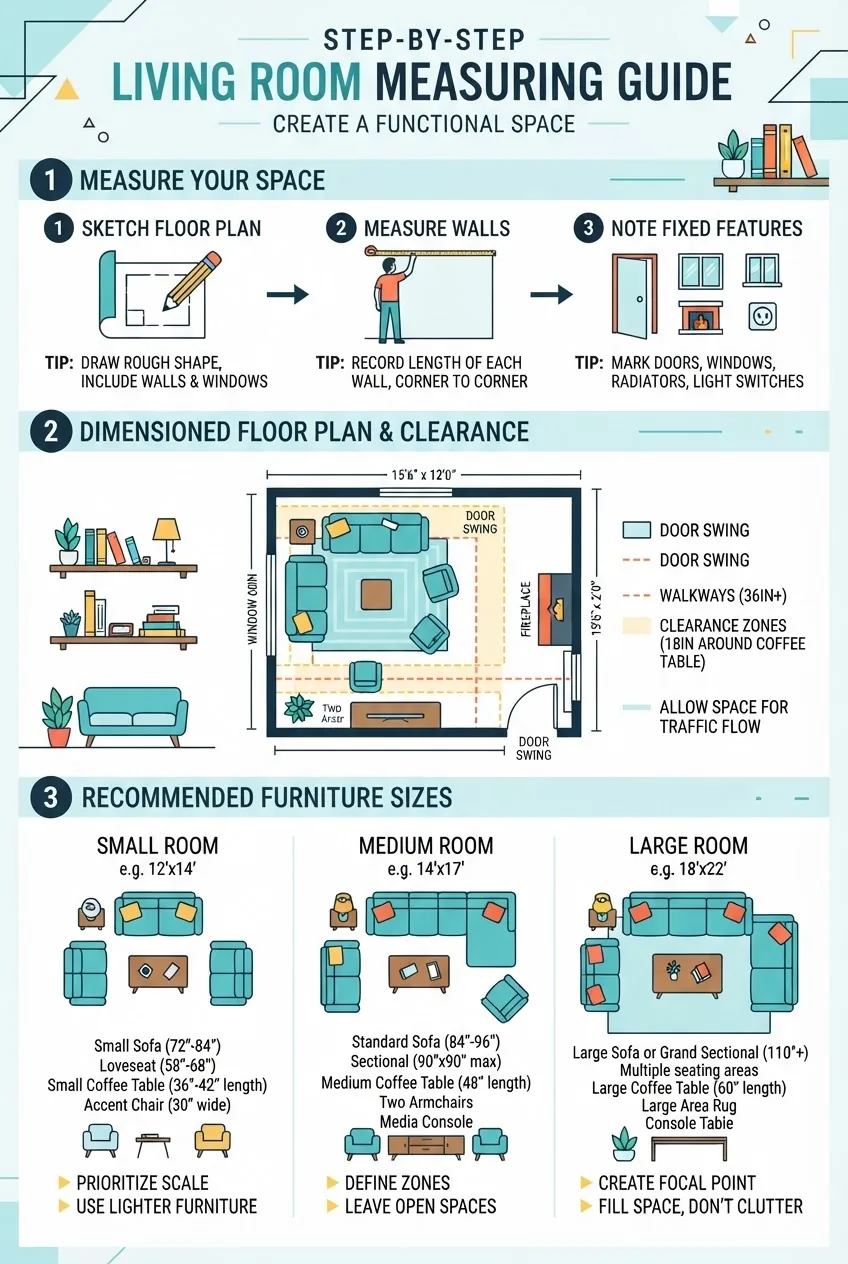
- Measure the room perimeter: Using a tape measure or laser, record wall-to-wall dimensions to the nearest 1/2″. Also measure wall heights and note baseboard and trim depths.
- Mark fixed features: Measure distances from walls to windows, doors, radiators and switches. Photograph each wall and label measurements on the photo.
- Record focal points: Note TV location, fireplace dimensions and mantel projection; allow 3–6″ clearance from combustible surfaces when placing furniture near a fireplace.
- Establish circulation zones: Mark primary walkways—keep 30–36″ clear in high-traffic zones; for narrow hallways accept 24″ minimum.
- Measure for sightlines: From seated eye height (about 40–42″ from floor), measure distance to TV to match screen size (TV diagonal roughly equals 0.6–0.75 × viewing distance in inches for 1080p; for 4K you can sit closer).
- Take door and elevator constraints into account: Measure door widths, stairwell turns and elevator restrictions if pieces are large or non-modular.
- Create a scaled sketch: Draw the room to scale on graph paper (1 sq = 1 ft) or use a simple CAD/room-planning app. Place furniture using the same scale to test fit.
Walkthrough example: For a 12′ × 16′ living room with TV on the 16′ wall, measure 16′ wall, note 6″ window sill on adjacent wall, door swing clearing 36″. For seating facing the TV, allow 8–12′ viewing distance for a 65″ TV. A 84″ sofa fits comfortably on the 12′ wall leaving 2′ circulation on each side.
living room furniture arrangement ideas — use this pillar resource to plan placement once pieces are chosen.
awkward living room layout solutions — if your room has unusual shapes.
accurate room measurements — techniques applicable across rooms.
room drawing and planning — for tool-assisted planning techniques.
space optimization in multi-storey homes — useful when accounting for stair and landing constraints.
small living room seating options — specialized seating advice for compact spaces.
small living room furniture tips — scaling guidance and dimension thresholds.
space planning techniques — broader principles to apply after sizing pieces.
Transition: With accurate measurements and scaled planning, focus on comfort and functionality to ensure your selections perform long-term.
-
Comfort and Functionality Considerations in Living Room Furniture Selection
Comfort is measurable: seat height, seat depth and cushion density define how a piece feels. Functionality includes storage, modularity, and multi-use features. Below are practitioner-tested highlights to guide choices.
- Seat height: 16–18″ for lounge sofas, 18–20″ for firm chairs—measure final height including cushions.
- Seat depth: 20–22″ for upright seating, 22–24″ for deep lounge sofas; add lumbar pillows for deeper seats.
- Cushion density: Foam density measured in pounds per cubic foot (PCF). For durable seating aim for 1.8–2.5 PCF high-resiliency foam with wrapped coil or down top for plushness.
- Suspension: Eight-way hand-tied springs are premium; sinuous springs are common and durable for mid-range pieces.
- Ergonomics: Check lumbar support and armrest height (usually 24–30″ from floor).
- Multi-purpose furniture: Ottomans with storage, sleeper sofas (measure mattress size—full or queen), nesting tables, and modular sectionals increase function without additional square footage.
- Reclining and motorized options: Factor in power availability and clearance; allow 6–12″ behind recliner backs for wall-hugger mechanisms.
- Pet- and child-friendly choices: Use fabrics with stain-resistant finishes, tighter weaves, and higher abrasion ratings; avoid fragile legs and low coffee tables that can be hazards.
comfortable seating options — detailed seating advice and setups.
shared space furniture ideas — for combined living/bedroom scenarios.
living and dining combo furniture tips — for multifunctional open plans.
open floor plan furniture considerations, open living room floor plans and flexible furniture for open floor plans — pick modular pieces and rugs to define zones.
second living room furniture — considerations when furnishing additional living spaces.
Transition: Comfort and functionality choices must be balanced with cost; next, set a realistic budget that matches your priorities.
-
Setting and Managing Your Budget for Living Room Furniture
Budgeting is a planning exercise: allocate funds by priority so key investment pieces receive the most resources. Follow the numbered tips below to build a defensible budget.
- Decide your total budget: Use a 3-tier model — Essential investment (50% of budget) for major seating and storage, Secondary items (30%) for tables and accent chairs, Accents (20%) for rugs, lighting and décor. Example: With a $5,000 budget, allocate $2,500 (sofa/media), $1,500 (tables/chairs), $1,000 (rug/lighting).
- Identify one investment piece: Spend more on the sofa or media console if those are the room’s daily workhorses—target 40–60% of essentials on the sofa if comfort and longevity are priorities.
- Compare cost vs. lifespan: Estimate item lifespan (sofa: 7–15 years; coffee table: 10–20 years). Paying 20–30% more for longer life often reduces lifetime cost per year.
- Use targeted savings: Save on side tables and accessories; splurge on frame and suspension quality for seating.
- Watch for hidden costs: Delivery, assembly, fabric upgrades, and return fees. Factor in a 10% contingency for extras.
- Timing and sales: Major sale windows (Presidents Day, Memorial Day, Black Friday) often yield 10–30% off; sign up for retailer alerts but avoid impulse upgrades beyond your plan.
- Financing and warranties: If financing, calculate total interest so you don’t pay more than the item’s value over time; prefer extended warranties for complex motorized pieces.
According to a 2024 industry report, consumers who adopt a prioritized budget model report higher long-term satisfaction with furniture purchases. Use the allocation model above and track purchases in a simple spreadsheet to stay on budget.
Transition: Once you’ve bought furniture, maintenance and sustainability play a role in longevity and costs — learn to maintain pieces and choose eco-friendly options.
-
Maintenance, Durability, and Sustainable Furniture Options
Good maintenance extends furniture life. Sustainability reduces environmental impact—consider certified materials and low-emission finishes.
Maintenance basics:
- Vacuum upholstered pieces weekly with upholstery attachment to prevent soil embedment.
- Rotate cushions every 1–3 months to even wear; fluff down inserts weekly for loft maintenance.
- Wipe wood surfaces with a damp cloth and dry immediately; avoid silicone polishes that break down finishes.
- For leather, clean with a damp cloth monthly and condition every 6–12 months using products recommended by the manufacturer.
- Follow manufacturer care instructions—improper cleaning voids many warranties.
Checklist for durability and sustainability:
- Check frame: kiln-dried hardwood frames with corner blocks and glued joints last longest.
- Inspect suspension: 8-way hand-tied or heavy-duty sinuous springs for high-use seating.
- Ask about flame-retardant chemicals and request low-VOC finishes when possible.
- Look for certifications: BIFMA standards for durability and safety; FSC (Forest Stewardship Council) for responsibly sourced wood; EPA guidance on indoor air quality.
- Consider the product’s expected lifespan vs. repairability: replace upholstery covers and cushions rather than entire frames when possible.
- For fabrics: choose natural fibers for low-impact disposal or high-recycled-content synthetics for durability; seek producer environmental claims with third-party verification.
According to a 2023 Consumer Report on furniture durability, items meeting recognized industry standards and with documented material certifications experience lower failure rates in the first five years. Cross-check warranty terms and inquire about parts availability before purchase.
Transition: With care and sustainability understood, decide whether to buy new, secondhand, or commission custom pieces.
-
Where and How to Buy Living Room Furniture: New, Vintage, or Custom
Each buying channel has trade-offs: new offers warranty and consistency, vintage provides character and value, custom gives fit and finish but costs more. Below is a comparison and pros/cons list to guide the purchase route.
Option When to choose Pros Cons New (retail) Standard sizes, warranties, fast availability Warranty, returns, consistent finishes Higher markup for brand; limited uniqueness Secondhand / vintage Unique pieces, lower price, sustainable choice Value, character, lower embodied-carbon footprint Unknown history, potential repairs, no warranty Custom / local maker Perfect fit, unique materials, special dimensions Tailored scale, finish choices, durable craftsmanship Higher cost, longer lead times (8–16 weeks typical) Pros and cons list (quick):
- Buy new if you need warranty-backed reliability and predictable delivery.
- Buy vintage for mid-century or artisan pieces; inspect joinery, ask for provenance and have a repair budget of 10–25% of purchase price.
- Commission custom for non-standard dimensions or to match architectural elements; expect 25–50% premium over retail for bespoke upholstery and hardwoods.
When buying online, confirm return windows, review dimensions and request fabric or finish swatches before committing. For large purchases, get a written delivery and damage policy and schedule delivery when someone can inspect items on arrival.
Transition: Final step—coordinate chosen pieces with existing décor to create a cohesive living room.
-
Top Tips to Coordinate Living Room Furniture with Your Existing Décor
Use color, texture and scale to weave new pieces into an existing palette. Choosing furniture is like dressing your living room in clothes that fit both function and style.
- Start with the dominant color: Pull 70% of the palette from walls and large fixed elements, then choose upholstery within that family for cohesion.
- Layer textures: Mix smooth (leather, lacquered wood) with textured (wool, boucle) to add depth.
- Balance scale: Use one large statement piece (sofa) balanced by multiple smaller pieces (chairs, ottomans).
- Add accent colors: Use accent pillows and art to introduce one bolder hue for contrast; limit to 2–3 accents.
- Repeat materials: Echo a metal or wood finish across 2–3 items (lamp base, coffee table legs, shelf) to tie the room together.
modern living room furniture and elegant living room furniture styles can guide final aesthetic choices.
Transition: Below are practical steps and checks to finalize your project, avoid common mistakes, and know when to call a pro.
Common mistakes and how to avoid them
I once specified a 110″ sectional for a client’s 12′ wall without checking doorways — it couldn’t be delivered whole and required costly reupholstery after a modular hack. Now I always measure delivery paths before buying. I also underestimated cushion density for a family with kids; cushions bottomed out in two years because I chose low-density foam — now I insist on 1.8–2.5 PCF for main seating. Finally, I’ve paired too many competing woods; the room felt chaotic until we limited wood tones to two families and brought in metal accents for contrast.
Final checklist
- Room measurements recorded to nearest 1/2″ and a scaled sketch created.
- Primary function and user count documented and prioritized.
- Key furniture pieces selected with dimensions and clearance confirmed.
- Materials and finishes chosen with maintenance plan and certifications checked (BIFMA, FSC where relevant).
- Budget allocated using the 50/30/20 model and contingency of 10% reserved.
- Delivery and return policies confirmed; delivery path measured.
- Warranty and parts availability verified for mechanical pieces.
When to call in a professional
Hire a pro if you need structural modifications (built-ins, fireplace clearances, wall reinforcements for heavy shelving), custom joinery beyond basic upholstery, or if the room is part of a larger renovation requiring electrical or HVAC adjustments. Expect design or contractor fees ranging from $75–$250/hour or fixed-project pricing; for custom upholstery and built-ins, allow 8–16 weeks for fabrication.
Conclusion: By following the steps above — clarifying function, choosing appropriate types and materials, measuring carefully, prioritizing comfort and budget, and selecting responsible buying channels — you’ll end up with a living room that’s comfortable, durable and visually cohesive. Ready to plan furniture placement once you’ve chosen pieces? living room furniture arrangement ideas. If you’re ready now, start with a room measurement session (1–2 hours) and a simple prioritized shopping list.